There are moments in diplomacy that do not require grand speeches to carry meaning.
Sometimes a simple public gesture says enough.
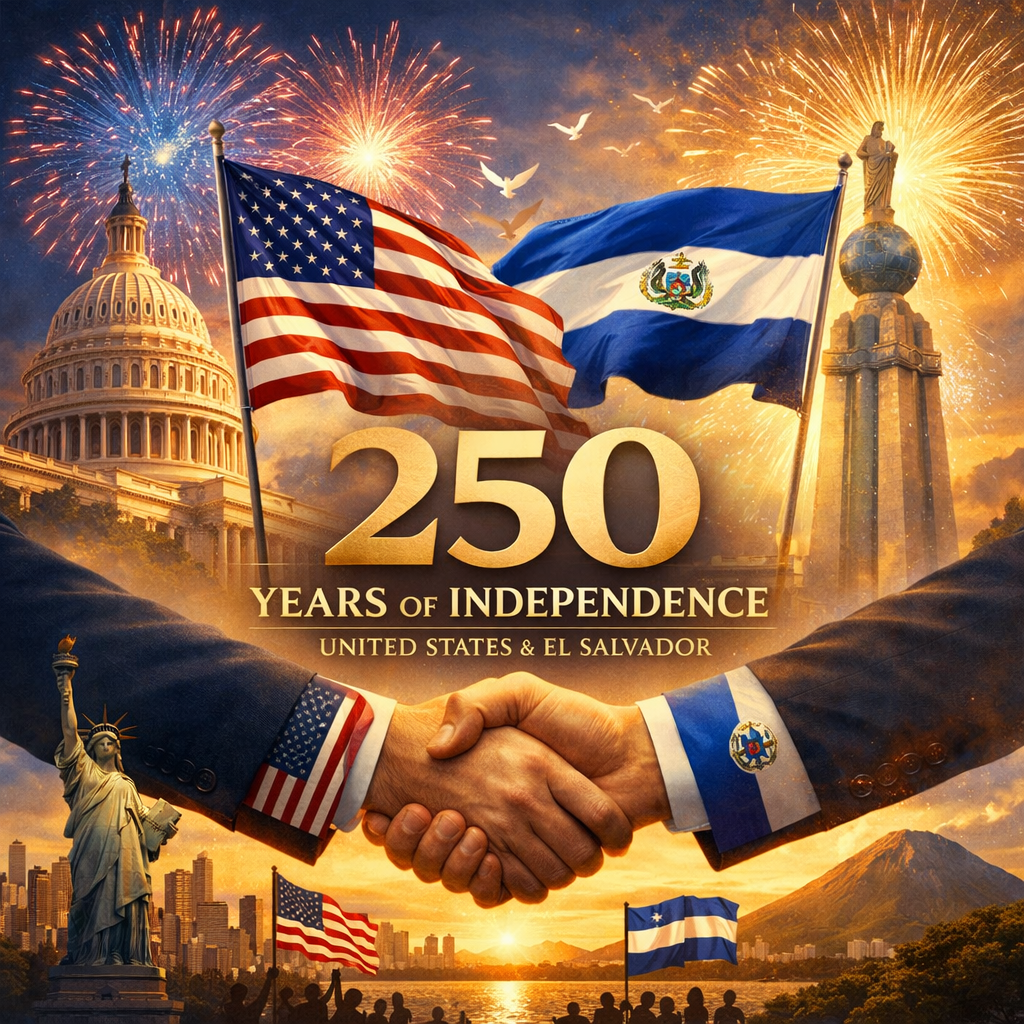
That is what happened when El Salvador’s Legislative Assembly issued an official pronouncement commemorating the 250th anniversary of the independence of the United States of America. The date, July 4, 2026, marks a historic milestone for the American people, but here in El Salvador, it also carries a deeper meaning because the relationship between these two countries is not only political. It is personal.
For generations, El Salvador and the United States have been connected through migration, family, work, investment, security cooperation, education, and shared history. Many Salvadorans have relatives in the United States. Many families here depend on the hard work and sacrifices of loved ones who built new lives there. For that reason, the Fourth of July is not some distant foreign celebration. It touches homes, families, and communities across this country.
A Gesture of Respect from the Legislative Assembly
According to reports, the Legislative Assembly approved the pronouncement with the support of 60 deputies, reaffirming ties of friendship, cooperation, and mutual respect between El Salvador and the United States. The document highlighted cooperation in areas such as trade, investment, security, education, technology, and cultural exchange.
That is important.
At a time when the world often feels divided, it matters when one nation pauses to recognize the history and importance of another. The Assembly’s message was not only about honoring an anniversary. It was also about recognizing a relationship that has shaped both countries in many ways.
The pronouncement described the United States as a nation whose founding principles of freedom, democratic representation, and respect for fundamental rights have influenced people beyond its own borders. It also recognized the role the United States has played in economic, political, and technological development internationally.
For El Salvador, this gesture reflects respect, but also reality. The two nations are deeply connected.
The Human Side of Diplomacy
When we talk about international relations, it is easy to use big words: trade, security, investment, migration, cooperation, development.
Those words matter, but they do not tell the whole story.
The real relationship between El Salvador and the United States can be seen in families. It can be seen in a mother in El Salvador waiting for a call from her son in Los Angeles, and It can be seen in remittances sent home after long days of work. It can be seen in Salvadoran communities that carry their culture, food, faith, and family values into American cities while still keeping their hearts tied to this land.
The Legislative Assembly recognized the Salvadoran diaspora as one of the strongest bridges between the two nations. That is exactly right. Salvadorans living in the United States have contributed to the economy and social fabric of both countries, while also keeping alive a connection that no border can erase.
That human bridge may be the most powerful part of the relationship.
Governments change. Policies change. Political winds shift. But families remain connected. Culture remains connected. History remains connected.
Why the Fourth of July Matters Here
The Fourth of July is an American holiday, but the values behind it are not limited to the United States.
Freedom, self-determination, resilience, and the desire to build a better future are ideas that people everywhere understand. Salvadorans understand them very well.
This is a country that has lived through hardship. It has known conflict, migration, insecurity, poverty, and uncertainty. It has also known courage, faith, family strength, and the determination to keep moving forward.
That is why this anniversary can resonate here. It reminds us that nations are not built in one day. They are built through struggle, sacrifice, mistakes, correction, and hope. They are built by people who believe tomorrow can be better than yesterday.
The United States began its journey 250 years ago with the Declaration of Independence. El Salvador has its own history, its own struggles, and its own path. But both nations understand that independence is not only a date on a calendar. It is a responsibility carried from one generation to the next.
A Relationship That Continues to Evolve
The relationship between El Salvador and the United States is not frozen in the past. It continues to evolve.
Today, both countries work together in areas that affect daily life: economic development, investment, security, technology, education, and regional stability. The Assembly’s pronouncement stated that the relationship is based on mutual respect, democratic values, the rule of law, and shared interests.
That does not mean everything is simple. No relationship between nations ever is.
There are difficult issues, especially around migration, TPS, security, and economic opportunity. But strong relationships are not built by avoiding difficult conversations. They are built by maintaining respect while working through them.
The U.S. Embassy in El Salvador has also been commemorating the 250th anniversary through its Freedom 250 initiative, including cultural, educational, and public diplomacy activities designed to highlight democracy, innovation, and exchange between both countries.
That matters because diplomacy should not live only in government buildings. It should also reach students, artists, business leaders, communities, and ordinary people.
More Than Politics
As an American living in El Salvador, I see this relationship from both sides.
I was born and raised in the United States. I served in the U.S. Army. I worked, raised a family, and lived most of my life there before retiring to El Salvador with my wife. Now this country is my home.
So when I see El Salvador honoring 250 years of American independence, I do not see it only as a political act. I see it as a gesture between two countries that have both shaped my life.
The United States gave me my beginning. El Salvador gave me a new chapter.
That is why this moment feels meaningful.
It reminds me that nations are not just governments. They are people, and families. They are memories and are the places that shape us and the relationships that help carry us forward.
A Moment to Reflect on Freedom
The Fourth of July is a celebration, but it should also be a moment of reflection.
Freedom is not something to take lightly. It must be protected, respected, and renewed. It needs to include responsibility, fairness, opportunity, and dignity, and mean something not only in speeches, but in the daily lives of people.
For Salvadorans, this anniversary can also be a reminder of their own journey. El Salvador is changing. It is rebuilding confidence, attracting attention, strengthening security, and looking for a larger role in the region and the world.
That path will require wisdom. It will require balance. It will require strong institutions, honest effort, and respect for the people who call this country home.
Freedom is not only about where a nation has been. It is also about where it chooses to go.
A Tribute from El Salvador
By commemorating the 250th anniversary of U.S. independence, El Salvador offered a gesture of friendship rooted in history, strengthened by migration, and carried forward through cooperation.
It was a reminder that the relationship between these two nations is not only written in agreements and official documents. It is written in the lives of people who move between both worlds, who send money home, who build families, who open businesses, who study, who work, and who dream.
On this Fourth of July, El Salvador joins the United States in recognizing freedom, resilience, and the enduring hope that tomorrow can be better.
Que esta celebración nos recuerde que la libertad es un camino compartido.
May our nations continue walking it together—with dignity, respect, and hope.
If you enjoy stories about El Salvador’s culture, development, tourism, and transformation, please consider liking, commenting, and sharing this article.
Leave a Reply