Category: Community Development

  • El Salvador Brings Free Healthcare and Essential Services to Communities Through Feria Integra

    El Salvador Brings Free Healthcare and Essential Services to Communities Through Feria Integra

    October 10, 2026

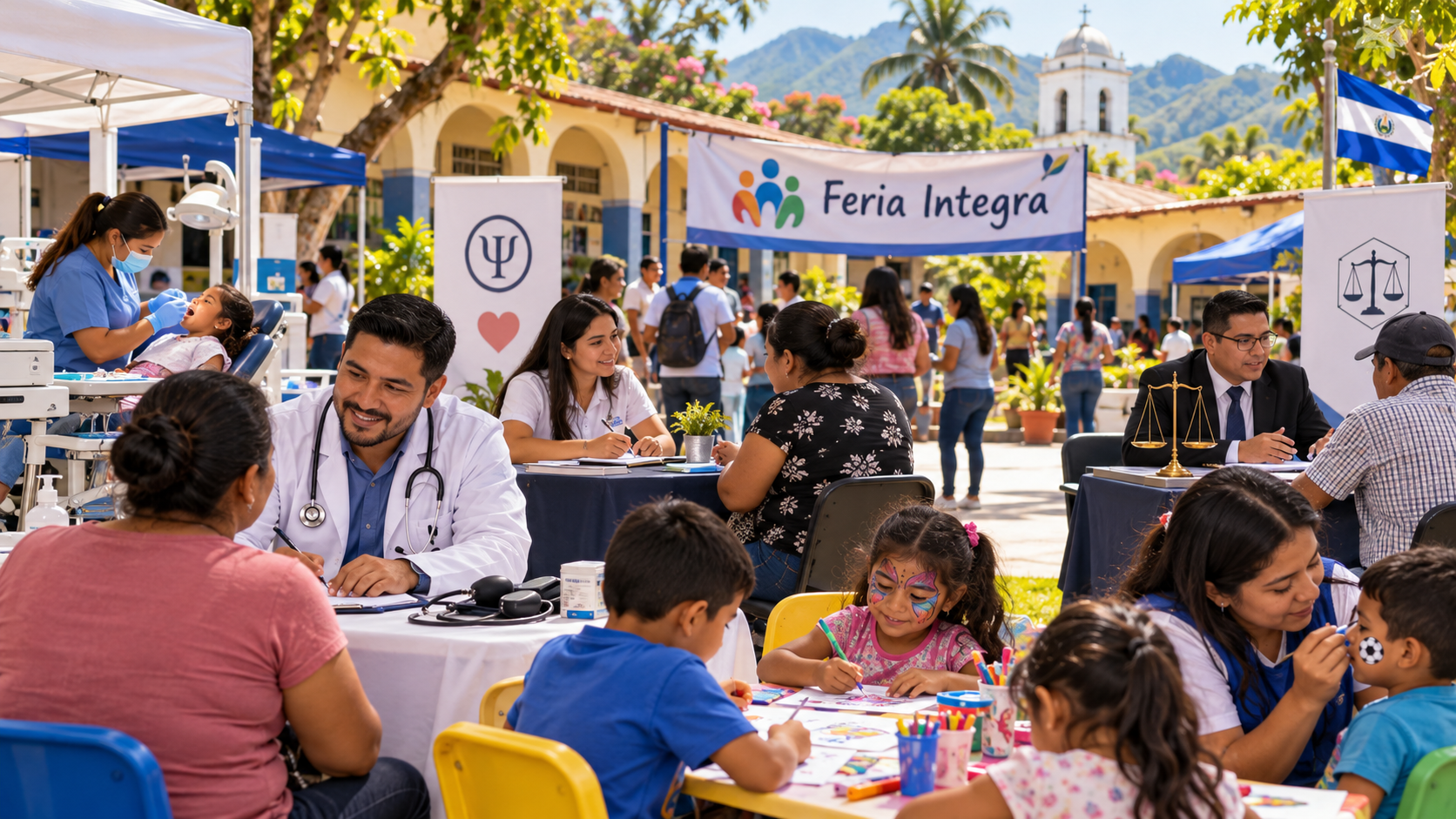
    Image: Healthcare professionals, legal advisers, and families at a community services fair in El Salvador. AI-generated for Our Life in El Salvador.

    Across El Salvador, government programs are working to bring essential services closer to families who might otherwise face difficulties obtaining them. On Saturday, October 10, the Dirección de Integración (Integration Directorate) continued that effort with a Feria Integra in Usulután.

    The event, held at the Instituto Nacional de Usulután, provided approximately 1,500 services, including medical consultations, dental care, psychological assistance, legal guidance, and recreational activities for children.

    For many Salvadoran families, having these services available in one location and at no cost can make a meaningful difference.

    Bringing Healthcare Directly to Communities

    One of the most important features of the Feria Integra program is its effort to reduce the barriers that prevent people from receiving basic medical attention.

    During the Usulután event, residents received general medical consultations, dental services, and clinical massage therapy. Medical personnel also provided prescribed medications at no charge.

    Patients requiring more specialized treatment could be referred to higher-level healthcare facilities for additional attention.

    This is especially important in communities where visiting a medical facility may require significant travel, transportation expenses, or time away from work.

    By bringing healthcare professionals directly into communities, the program seeks to make basic services more accessible.

    Legal Assistance and Psychological Support

    The fair also addressed needs beyond physical healthcare.

    Professionals from the Procuraduría General de la República (PGR), El Salvador’s public legal assistance institution, provided guidance to residents seeking help with legal matters.

    Psychological assistance was another important part of the event. Professionals attended to individuals needing support and followed up on previously identified cases.

    These services recognize that improving community well-being involves more than treating physical illnesses.

    Legal concerns, emotional health, and family circumstances can all influence a person’s quality of life.

    Activities for Children and Families

    While adults received medical attention and other assistance, children participated in activities designed to encourage creativity and enjoyment.

    The fair included face painting, painting workshops, and recreational games.

    Providing activities for children allows these events to serve as community gatherings as well as service centers.

    It also creates opportunities for families to participate together in a welcoming environment.

    A Program Reaching Communities Throughout El Salvador

    The Feria Integra initiative is not limited to Usulután.

    According to the Integration Directorate, the program brings essential services to urban and rural communities throughout the country, including areas where access to healthcare and professional assistance may be limited.

    The organization identifies poverty and the lack of access to basic services as important challenges that the initiative seeks to address.

    Earlier this year, Feria Integra events also took place in other departments, including Santa Ana, San Miguel, and Ahuachapán.

    On October 3, a fair in Santa Ana provided approximately 1,500 services. Organizers also arranged free transportation for some residents traveling from nearby communities.

    Usulután has benefited from previous events as well. In July 2025, the Integration Directorate announced that approximately 3,000 services were being made available during another fair in the department.

    These events demonstrate an ongoing effort to reach Salvadorans through regular community visits.

    More Feria Integra Events Scheduled for October

    The Integration Directorate has announced additional events during the remainder of October 2026.

    Upcoming locations include:

    • October 17: Tonacatepeque, San Salvador.
    • October 21: San Sebastián, San Vicente.
    • October 28: Sonsonate.
    • October 31: Cojutepeque, Cuscatlán.

    Residents interested in attending should consult the official Integration Directorate schedule for updated locations and arrangements.

    Why These Programs Matter for Rural El Salvador

    At Our Life in El Salvador, we frequently report on infrastructure improvements, tourism, economic development, and education. However, programs that affect the everyday lives of ordinary Salvadorans deserve attention as well.

    For families living outside major population centers, obtaining healthcare and other essential services is not always convenient.

    Transportation costs, travel time, and limited household resources can discourage people from seeking assistance.

    A medical consultation that is readily available in a large city may present a much greater challenge for someone living in a remote community.

    This is why initiatives that bring services closer to residents can be particularly valuable.

    The availability of free medications is another important consideration. Receiving a medical diagnosis is only part of the process. Access to prescribed treatment can be equally important.

    Of course, community healthcare fairs cannot replace a permanent and comprehensive healthcare system. Their greatest value may be in extending access, identifying medical concerns, and connecting residents with additional services.

    Whether these efforts produce lasting improvements will also depend on the availability of follow-up care and continued support.

    Building Stronger Communities

    The Feria Integra in Usulután illustrates how several public services can be brought together to address different community needs.

    Healthcare professionals, legal advisers, psychological support personnel, and recreational organizers contributed to an event intended to assist families in several ways.

    The reported 1,500 services represent more than a figure in a government report. Behind those services are individuals seeking medical attention, advice, reassurance, or assistance with everyday challenges.

    For a country continuing to develop its infrastructure and public services, programs like Feria Integra are another part of the larger story of El Salvador’s development.

    At Our Life in El Salvador, we believe these community initiatives are worth following, particularly as they expand into rural areas where access to services can be more difficult.

    If you enjoy reading about El Salvador’s development, economy, tourism, culture, environment, and continuing transformation, please consider liking and sharing this article. Your comments help start conversations, and subscribing ensures you never miss a new post. Every interaction helps our blog reach more readers and lets us keep sharing stories about life in El Salvador.

    Sources and Additional Information

    Diario El Salvador, Eduardo De la O, October 10, 2026.

    Diario El Mundo, October 10, 2026.

    Dirección de Integración: Feria Integra and official events agenda.

  • Rural Water-System Expansion Benefits More Than 3,200 People in Ahuachapán Sur

    Local family benefiting from improved drinking-water infrastructure in rural Ahuachapán Sur. AI image Generated for Our Life in El Salvador

    More than 3,200 residents of San Francisco Menéndez now have access to an improved rural drinking-water system following an investment supported by El Salvador and Spain.

    The project benefits 3,271 people in the urban center of La Hachadura, Colonia Paola and Comunidad Paz y Progreso 2. These communities are part of San Francisco Menéndez in Ahuachapán Sur.

    This story is especially important to me because Elizabeth and I live in Cara Sucia, which is also part of San Francisco Menéndez. Although the upgraded system does not directly serve Cara Sucia, it is encouraging to see this type of investment reaching communities in our area.

    New Water Connections for 34 Families

    One of the project’s most important accomplishments was connecting 34 additional families to the drinking-water system for the first time.

    These families joined 951 households that were already receiving service. The system now supplies water to approximately 985 families.

    For those receiving their first household connection, this represents more than a construction project. Reliable access to drinking water can make everyday life easier and improve sanitation, health and living conditions.

    Water is something people may take for granted when it is always available. However, in rural communities, interruptions and limited access can create serious difficulties for families.

    Improvements to the Water System

    The project included several improvements designed to make the system more reliable and efficient.

    Workers repaired and waterproofed the distribution tank. This should help reduce leaks and prevent the unnecessary loss of water.

    A new building was also constructed for the pumping station. Electrical equipment, transformers and a substation were installed to support its operation.

    According to the National Administration of Aqueducts and Sewers (ANDA), the work also included improvements and interconnections within the distribution network. New household connections were then installed for the additional families.

    A meter was placed at the water source to measure the amount of water being extracted. Accurate measurements will allow the system’s operators to monitor water use and manage the available supply more responsibly.

    ANDA says the improvements should provide residents with a more efficient and continuous water service.

    Protecting the Water Source

    The project was not limited to pipes, pumps and electrical equipment. It also included measures to protect the natural water source that supplies the system.

    Drainage channels, living barriers and terraces were constructed to reduce erosion around the source. These measures can help prevent soil and sediment from damaging the surrounding land and affecting the water supply.

    The community also participated by planting 1,000 fruit and forest trees.

    A nursery and storage facility were established so that reforestation and environmental protection efforts can continue. This is important because a rural water system depends not only on working equipment but also on the long-term health of the land surrounding its source.

    Infrastructure can be repaired or replaced, but protecting the source itself is necessary to ensure that water remains available for future generations.

    Training the Local Water Association

    The rural water system is administered by the Asociación Rural de Agua Potable El Manantial La Hachadura, commonly known as ARAPEHM.

    Its directors and operational personnel received training as part of the project. The subjects included responsible water use, administration, system operation, gender equality and the human right to water and sanitation.

    This training may not attract as much attention as a new pumping station or distribution tank, but it is an essential part of the project.

    New equipment alone cannot guarantee dependable service. The system must also be properly operated, maintained and financially administered after the construction work is completed.

    Strengthening the local association should help protect the investment and improve the system’s long-term sustainability.

    A Joint Investment

    The improvements required an investment of $119,325.18.

    The Spanish Cooperation Fund for Water and Sanitation, administered through the Spanish Agency for International Development Cooperation, contributed $100,427.50. ARAPEHM provided the remaining $18,897.68.

    ANDA and the Spanish development agency supported the delivery of the completed project.

    The cooperation between an international development agency, a national government institution and a local community organization is one of the story’s most encouraging aspects. Each organization contributed to a project that addresses a basic need for local families.

    An Important Improvement for Our Area

    Living in Cara Sucia, I understand how important dependable water service is to families throughout San Francisco Menéndez.

    Our district includes urban centers and many rural communities, and their infrastructure needs are not always the same. Some families have dependable household connections, while others may experience interruptions or have more difficulty obtaining water.

    This particular project is centered on La Hachadura, Colonia Paola and Comunidad Paz y Progreso 2. Therefore, it should not be presented as an expansion of water service throughout all of San Francisco Menéndez.

    Nevertheless, the project demonstrates what can be accomplished when government institutions, international partners and local residents work together.

    The addition of 34 new household connections is welcome progress. The repairs and electrical improvements should also provide better service to hundreds of families already connected to the system.

    Perhaps most importantly, the project combines immediate infrastructure improvements with long-term environmental protection. The new equipment will help deliver water today, while the erosion-control measures and reforestation work may help preserve the source for years to come.

    For the 3,271 people who depend on this rural system, reliable drinking water is not a minor improvement. It is an essential service that affects nearly every part of daily life.

    Sources: Diario El Salvador and ANDA

    If you enjoy reading about El Salvador’s development, economy, tourism, culture, environment, and continuing transformation, please consider liking and sharing this article. Your comments help start conversations, and subscribing ensures you never miss a new post. Every interaction helps our blog reach more readers and lets us keep sharing stories about life in El Salvador.

  • El Salvador Ratifies Agreement Supporting Peace Corps Volunteers

    Peace Corps volunteers work alongside Salvadoran residents to develop locally led economic and community projects.

    AI Generated Image for Our Life in El Salvador

    The Legislative Assembly of El Salvador has unanimously ratified an updated agreement with the United States governing the work of Peace Corps volunteers in the country.

    All 60 deputies voted in favor of the agreement on September 17. The decision creates an updated legal framework for a new stage of cooperation between El Salvador and the Peace Corps.

    The agreement covers the supervision, training and protection of volunteers. It also establishes administrative, immigration, tax and customs arrangements needed for the program to operate.

    The vote is significant because of the Peace Corps’ long history in El Salvador and the circumstances that caused it to leave the country twice.

    A Relationship Dating Back to 1962

    President John F. Kennedy established the Peace Corps in 1961. The organization began working in El Salvador the following year.

    Volunteers remained in the country until approximately 1979–1980, when the growing conflict forced the organization to suspend its work.

    The Peace Corps returned after El Salvador’s Peace Accords and began a second period of service. That period ended in 2016 because violence associated with gangs made it unsafe for volunteers to continue working in many communities.

    The governments of El Salvador and the United States signed a new agreement on September 7, 2023. The first group of volunteers under the renewed program arrived in September 2024.

    Therefore, the latest vote does not mean that the first volunteers will only now begin arriving. Volunteers have already returned. The ratification updates and formalizes the legal conditions under which the program can continue and expand.

    What the New Agreement Covers

    The new agreement consists of 10 articles and replaces an earlier bilateral arrangement dating from 1961.

    It defines the responsibilities of El Salvador and the United States in several areas, including:

    • Volunteer supervision and training
    • Safety and protection
    • Administrative and immigration procedures
    • Funding arrangements
    • Tax and customs exemptions
    • Coordination between the two governments

    The agreement allows the Salvadoran government to request volunteers for mutually approved projects. The United States will decide whether to approve and provide those volunteers.

    Officials explained that the agreement does not require El Salvador to make a fixed financial contribution to the program.

    It does provide certain tax and customs exemptions for equipment, supplies and other materials imported for Peace Corps projects. Financial arrangements for individual projects can be established as the program develops.

    The agreement does not have a fixed expiration date. Either government may terminate it by providing written notification. The termination would take effect 90 days later.

    One More Step Before It Takes Effect

    Although the Assembly has ratified the agreement, one final diplomatic procedure remains.

    The agreement will officially take effect after El Salvador and the United States exchange notifications confirming that both governments have completed their internal requirements.

    That process is different from another legislative vote. The Salvadoran Assembly has completed its part by approving the agreement unanimously.

    What Will the Volunteers Do?

    During the legislative discussion, officials mentioned several areas where Peace Corps volunteers could provide assistance. These included agriculture, education, health, environmental work, leadership and youth development.

    Officials also acknowledged that the final priorities will depend on studies and requests made as the program develops.

    The current Peace Corps website provides more specific information. It identifies two main programs operating in El Salvador: Community Economic Development and Youth Development.

    Supporting Rural Economic Development

    The Community Economic Development program is intended to help rural Salvadoran households create and strengthen economic opportunities.

    Volunteers are expected to work particularly with women and young people. Their activities may include:

    • Teaching personal money-management skills
    • Helping organize community savings groups
    • Providing basic business and entrepreneurship training
    • Supporting small income-producing activities
    • Teaching digital skills
    • Offering English instruction for businesses serving international visitors

    English training will be offered selectively to artisans, tourism businesses and others whose products or services are aimed at American visitors.

    Volunteers may work alongside the Ministry of Tourism, the National Commission for Micro and Small Enterprises, known as CONAMYPE, community development associations and other local organizations.

    This part of the program could be particularly valuable in rural communities. Many Salvadorans have good ideas and useful skills but need assistance with planning, recordkeeping, promotion or reaching new markets.

    Working With Salvadoran Youth

    The Youth Development program will involve cooperation with public schools, municipalities, community leaders and civil society organizations.

    Volunteers may help organize sports, art, music and debate clubs. They can also assist with leadership camps, recreational activities and community projects.

    The program is intended to strengthen skills such as:

    • Communication
    • Decision-making
    • Problem-solving
    • Resilience
    • Leadership
    • Goal-setting

    Another goal is to improve communication between young people and their parents while helping families participate in planning for the future.

    Positive activities and strong community connections can give young people confidence and a sense of purpose. These opportunities are valuable in any country, especially in rural communities where organized programs may be limited.

    Communities Will Help Identify Their Needs

    Peace Corps volunteers are not intended to arrive with a project already decided in Washington.

    The organization says volunteers will conduct assessments with community leaders, educators and local organizations. They will then work with those partners to identify priorities and develop plans.

    That collaborative approach is important. People living in a community understand their needs better than visitors do.

    A volunteer can bring knowledge, energy and a different perspective. Salvadorans contribute local experience, cultural understanding and knowledge of what can work over the long term.

    The strongest projects will combine both.

    Life in Salvadoran Communities

    Many Peace Corps volunteers will be assigned to rural areas. They generally serve for two years after completing approximately three months of language, cultural and technical training.

    According to the Peace Corps, volunteers will commonly live in a private room inside the home of a Salvadoran host family. Some communities may have intermittent electricity or running water, and volunteers may walk or use public buses for transportation.

    Living within the community helps volunteers understand the people with whom they work. It also promotes the cultural exchange that has always been an important part of the Peace Corps mission.

    The experience is not one-sided. Volunteers share their skills, but they also learn from Salvadoran families, traditions and communities.

    A Sign of Changing Conditions

    The return of the Peace Corps has another meaning for El Salvador.

    The organization withdrew in 2016 because the country’s violence made continued operations unsafe. Less than a decade later, volunteers are once again preparing to live and work in rural Salvadoran communities.

    That change would have been difficult to imagine several years ago.

    Security alone will not determine whether the renewed program succeeds. The projects must be useful, well-managed and supported by the communities they are intended to serve.

    Nevertheless, the willingness of American volunteers to return is an encouraging indication of how perceptions of El Salvador have changed.

    Questions Still Need Answers

    Several details have not been made public.

    We still do not know exactly how many Peace Corps volunteers are currently serving in El Salvador. The government and the organization have not identified all the departments where volunteers are assigned.

    It is also unclear how many additional volunteers may arrive under the updated agreement.

    The public should eventually receive information about the projects being carried out, the communities participating and the results being achieved. Transparency will help Salvadorans understand whether the renewed partnership is creating lasting benefits.

    For security reasons, it may not be appropriate to release the precise location of every volunteer. However, general information about the number of volunteers, participating departments and completed projects should be available.

    A Positive Form of Cooperation

    As an American who has lived in El Salvador since 2011, I see value in cooperation that brings people from the two countries together at the community level.

    Government agreements are often discussed in terms of politics, trade or diplomacy. Peace Corps volunteers build relationships in a more personal way. They live with Salvadoran families, work beside local residents and become part of the communities they serve.

    The unanimous legislative vote gives this relationship an updated foundation.

    The next step is to ensure that the projects respond to genuine community priorities and produce benefits that continue after each volunteer completes their service.

    If that happens, the renewed Peace Corps program can strengthen local economic opportunities, support young people and deepen the relationship between El Salvador and the United States.

    What kind of Peace Corps project would be most helpful in your community? Please share your thoughts in the comments. If you find our coverage useful, liking and sharing this article helps more readers discover our blog. Subscribing will also help you follow future stories about El Salvador’s communities and development.

    Sources: Radio YSKL, Legislative Assembly of El Salvador, and Peace Corps projects