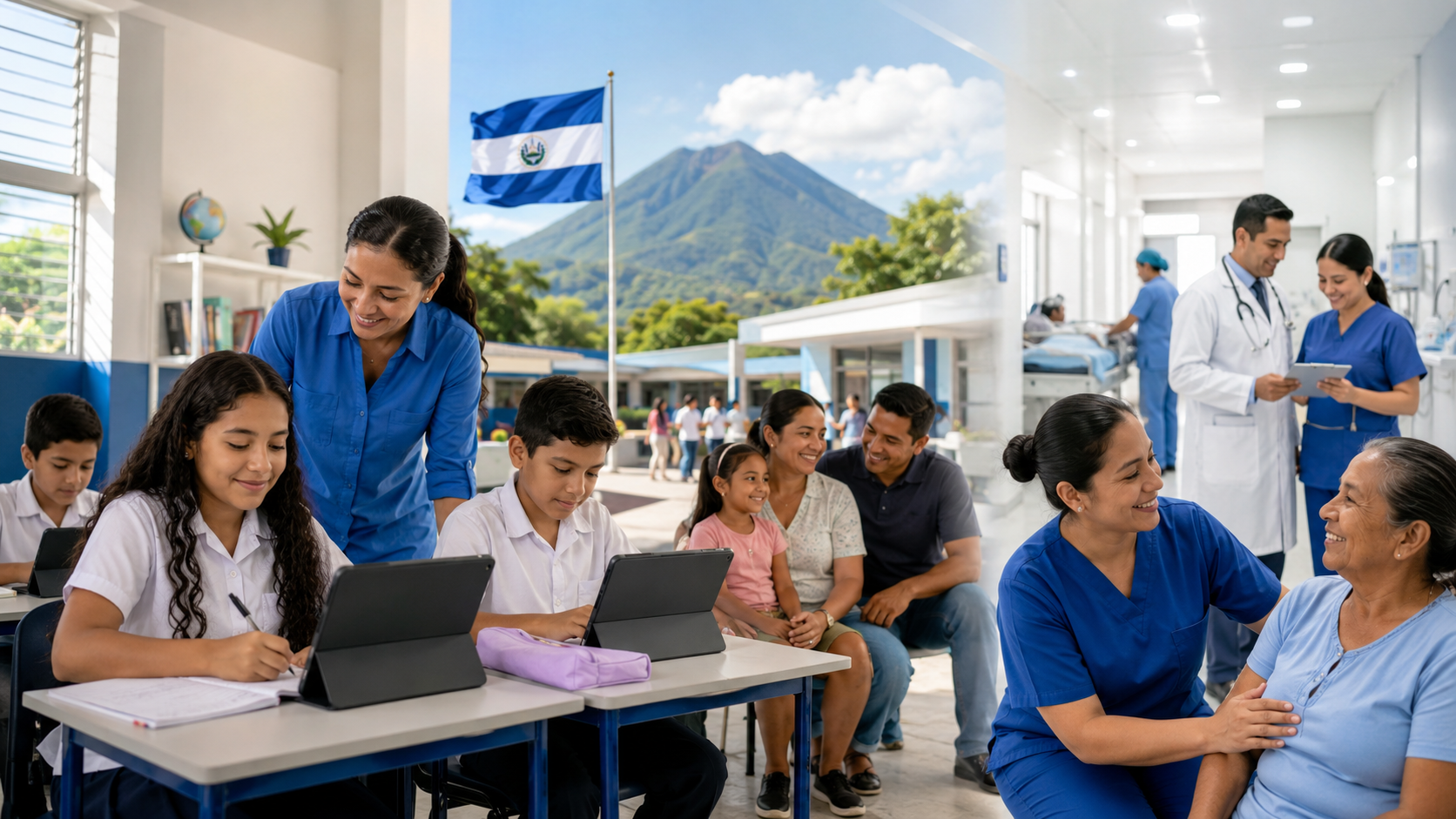
El Salvador education and health improvements are becoming part of the national conversation as many families report seeing changes in schools, clinics, and hospitals.
A new public opinion survey is giving a clear look at how many Salvadorans feel about two areas that touch daily life more than almost anything else: education and health.
According to the latest Iudop/UCA evaluation of President Nayib Bukele’s seventh year in office, 80.4% of respondents said public education has improved, while 59.5% said the quality of attention in the public health system is better. The survey was carried out from May 15 to May 26, 2026, through 1,271 in-person interviews across the country, with a 95% confidence level and a margin of error of ±2.75%.
These numbers matter because they reflect more than politics. They show how families are experiencing services in their own communities — the school their children attend, the clinic they visit, and the public institutions they depend on.
Education Stands Out
The strongest public response came in the education sector. In the survey, 80.4% of Salvadorans said the quality of public education has improved during this period, while 9.8% said it has worsened and 8.1% said it remains the same.
That is a significant response, especially in a country where public schools have faced years of challenges. For many families, education is not an abstract government program.For many families, education is deeply personal. It begins in the classroom where a child learns to read, but it also includes the school building itself, the materials students receive, the uniforms they wear, the technology they use, and the safer environment that helps them learn with confidence.
Across El Salvador, school renovations, student support programs, and new technology have become part of the national conversation. These efforts are visible, and when people can see change with their own eyes, it shapes how they judge progress.
For parents, small things can make a large difference. A backpack, a uniform, learning materials, or a better-equipped classroom can reduce pressure on the household. It can also give children a stronger sense of dignity when they walk through the school gate.
Health Care and Daily Experience
The health sector also received a favorable response, though not as high as education. According to the survey, 59.5% of respondents said the quality of attention in the public health system is better, while 24.2% said it is worse and 13.5% said it remains unchanged.
Health care is one of the most sensitive areas of public life. People judge it not only by buildings or announcements, but by what happens when they need help. Was the patient attended to? Was the wait reasonable? Were services organized? Did the family feel respected?
In that sense, perception becomes important. It does not replace a technical audit or a full review of hospital resources, medicine supply, staffing, or long-term outcomes. But it does show whether people feel a difference when they seek care.
Digital health initiatives are also becoming part of this conversation. The survey asked about DoctorSV, including its second phase focused on patients with chronic illnesses. On that question, 46.6% said the program responds “mucho” to the needs of people with chronic conditions, while 18.6% said “algo.”
For patients dealing with diabetes, hypertension, kidney problems, or other long-term conditions, better follow-up can mean less uncertainty. Families do not want health care only when there is an emergency. They need guidance, organization, and access before a situation becomes critical.
Perception Is Not the Whole Story — But It Matters
It is important to be fair about what a survey can and cannot tell us.
Public opinion is not the same as a medical report, school performance review, or budget analysis. It does not answer every question about cost, staffing, equipment, medicine availability, or long-term results.
But perception is still a social indicator. When people say education and health are moving in a better direction, they are speaking from lived experience. They are responding to what they see, hear, and feel in their communities.
That matters.
A government can publish plans and numbers, but families measure progress differently. Families recognize progress in practical ways: when their child receives better support at school, when a clinic visit feels more organized, when a hospital provides more attentive care, and when public services begin to feel closer, more modern, and more reliable.
A Country Watching Its Own Transformation
El Salvador continues to move through a period of big change. Some of that change is debated, and Some are celebrated. Some still need more explanation, more transparency, and more time to prove their lasting value.
But surveys like this help capture the national mood. They show where people believe progress is happening and where expectations remain high.
In education, the public response is especially strong. In health, the numbers also show a majority seeing positive movement, while reminding us that many people still believe more work is needed.
That balance is important. Progress should be recognized, but public services must always continue improving. Schools need constant investment. Hospitals need resources. Digital tools must be reliable and accessible. Families need to feel that the system works not only in announcements, but in daily life.
A Positive Sign for Salvadoran Families
For me, the most important part of this survey is not just the percentage. It is what those numbers represent.
They represent parents who feel their children have better opportunities, and patients who sense changes in public health care. They represent communities watching their country move in a new direction.
Education and health are two of the foundations of any nation. When people begin to feel progress in those areas, it strengthens confidence in the future.
El Salvador still has challenges. No serious person would deny that. But when a majority of Salvadorans say they are seeing gains in schools and health services, that is worth paying attention to.
It shows that the transformation of the country is not only being discussed in government offices or newspaper headlines.
It is being noticed by the people who live it every day.
A Personal Note on Health Care
I have to be honest: the 59.5% number on health care surprised me.
I do not know exactly who was surveyed, but I live here, and I have used the public health system myself. In 2016, I had heart surgery in a hospital in San Salvador. That operation saved my life. At that time, the hospital building and conditions were in very bad shape, but the doctors were outstanding. They worked with skill, dedication, and compassion, even when the system around them clearly needed improvement.
That is why the changes in health care under President Bukele stand out so strongly to me. Anyone who remembers how things looked before and sees what is happening now can recognize that the country has made major progress. Hospitals have been renovated, new facilities have opened, technology has improved, and public health has become a much greater national priority.
This does not mean every problem has disappeared. No health system is perfect, and there will always be patients who experience delays, shortages, or frustration. But from my own experience living here, the difference between then and now is dramatic.
For me, this is not just a statistic. It is personal. I saw the old system up close, and I am seeing the new investments with my own eyes. That is why I believe the progress in health care deserves more recognition than that number alone may suggest.
If you enjoy stories about El Salvador’s culture, development, tourism, and transformation, please consider liking, commenting, and sharing this article.
Leave a Reply