How science, mangroves, and local communities are helping protect one of the country’s endangered sea turtles
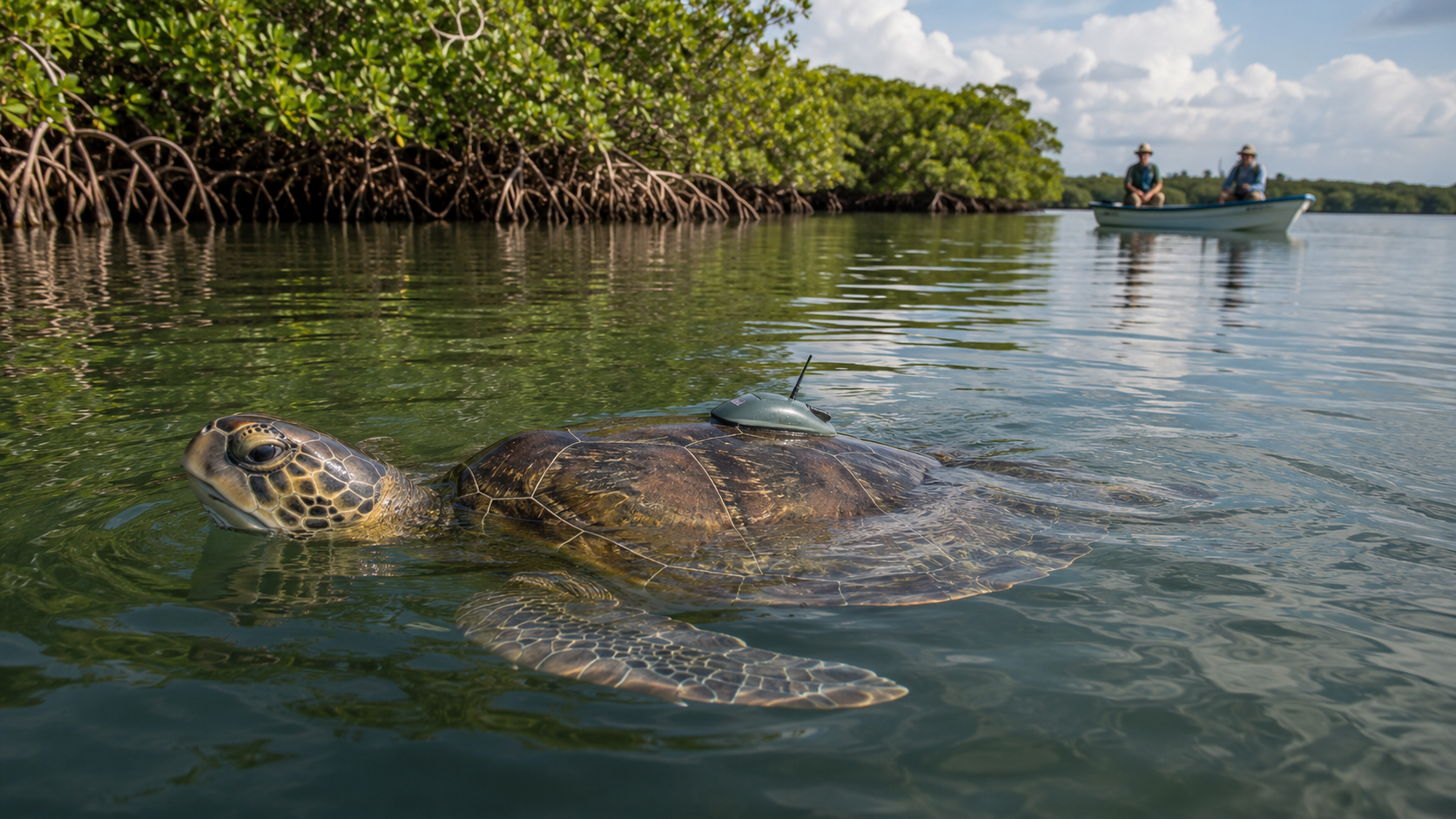
In Bahía de Jiquilisco, the movement of one endangered sea turtle is helping El Salvador see its coastline in a new way. Through a pioneering satellite tagging program, the tortuga prieta, or black turtle, is beginning to reveal a journey that has long taken place beyond human view. According to a recent report in Diario El Salvador, this effort allows scientists and conservation groups to follow the turtle’s movements in real time, opening a clearer window into how this species lives, feeds, and travels through Salvadoran waters.
For a country with a small coastline, this is a significant step. It shows that El Salvador’s beaches, mangroves, and wetlands are not only places of beauty and daily life. They are also living laboratories, where science, community, and conservation are beginning to work together in a deeper way.
A New Chapter for the Tortuga Prieta
The initiative is being carried out by Fundación Naturaleza El Salvador, FIAES, Red Xiuhtic, and the Ministry of Environment and Natural Resources, known as MARN.
Their focus is the tortuga prieta, a Pacific population of the green sea turtle. In El Salvador, this species is considered endangered, and much of its life remains difficult to study because it spends most of its time in the ocean.
Only females come ashore to nest, and even that happens during limited periods. For the rest of their lives, these turtles move through waters most people never see. They feed, rest, travel, and survive in places that have often remained invisible to science.
That is why satellite tagging matters.
Until now, much of the country’s satellite research on marine turtles had focused on the critically endangered hawksbill turtle, known in El Salvador as the tortuga carey. Expanding this technology to the tortuga prieta opens a new window into how another important species uses Salvadoran waters and the wider Pacific.
This is not just a technical project. It is a milestone for marine conservation in El Salvador.
Why Bahía de Jiquilisco Matters
Bahía de Jiquilisco is one of El Salvador’s most important coastal ecosystems. It is a Ramsar wetland recognized internationally for its ecological value and contains a rich mix of mangroves, channels, seagrass beds, reefs, beaches, and coastal communities.
For the tortuga prieta, this area offers more than a place to pass through. It provides food, shelter, resting zones, and nesting areas. The same mangroves that protect coastlines and support fish populations also help sustain endangered wildlife.
This is one reason the satellite project is so important. It reminds us that conservation cannot be limited to one beach, one nesting season, or one species. A sea turtle’s life connects many habitats. If one part of that chain is damaged, the whole system suffers.
Protecting the tortuga prieta also means protecting mangroves, seagrass beds, coastal waters, and the communities that depend on them.
How Satellite Tagging Works
The project uses small satellite transmitters attached to the turtle’s shell. These devices are placed carefully on the carapace using materials designed to hold in saltwater without harming the animal.
When the turtle surfaces or the equipment contacts water, the transmitter sends signals through a satellite tracking system. Over time, those signals create a map of the turtle’s movements.
Researchers can begin to understand where the turtles travel, where they feed, how they use the mangroves, and what areas may need stronger protection.
The technology used in the program includes SPOT satellite transmitters and the Argos tracking system. These tools allow conservation teams to receive valuable location data and study behavior that would otherwise remain hidden.
The most important part is that this work follows scientific and animal-welfare protocols. During the training process, participants learned how to prepare, attach, and monitor the devices in a way that protects the health and natural behavior of the turtles.
Science must never come at the expense of the animal it is trying to protect. This project recognizes that balance.
Training Local Hands for Long-Term Conservation
One of the most encouraging parts of this initiative is the local participation behind it.
The training in Bahía de Jiquilisco brought together biologists, veterinarians, field technicians, community leaders, and organizations connected to marine turtle conservation. Many of these people already work close to the beaches, mangroves, and coastal communities where turtles nest or feed.
That matters.
Conservation is strongest when local people are not treated as outsiders to the science, but as partners in it. The people who live near the mangroves, patrol the beaches, protect nesting sites, and understand the rhythm of the coast carry knowledge that cannot be replaced by technology alone.
Satellite transmitters provide data. Communities provide presence, memory, care, and daily commitment.
When both come together, conservation becomes more complete.
What the First Turtles Are Teaching Us
The first phase of the project has already tagged four tortugas prietas. The broader study plans to monitor up to eight individuals, giving researchers a better understanding of how this species uses the Salvadoran coast.
Early information has revealed a fascinating pattern. When the tide rises, the turtles enter the mangrove areas. When the water level drops, they return toward the open ocean.
That detail may sound simple, but it carries a powerful message. It shows that the tortuga prieta is not only tied to beaches or open water. It also depends on the mangrove forest.
This finding strengthens what conservationists have been saying for years: mangroves are not empty swamps or wasted land. They are nurseries, feeding grounds, natural barriers, and wildlife corridors. They protect life in ways that are not always visible from the road or the shoreline.
For the black turtle, the mangroves of Bahía de Jiquilisco may be part of a daily survival pattern.
From Turtle Signals to Better Decisions
Every signal sent by a tagged turtle becomes more than a point on a map. It becomes information that can guide decisions.
This data can help researchers and government institutions identify key feeding areas, resting zones, travel routes, and habitats that need protection. It can also support environmental education programs in nearby communities.
That is where science becomes practical.
A map can help shape a conservation plan. A movement pattern can help protect a feeding area. A better understanding of habitat use can guide local outreach, fishing practices, school programs, and regional cooperation.
El Salvador is part of the Eastern Pacific, a region where marine species do not stop at national borders. A turtle that feeds in Salvadoran waters may later travel far beyond them. This makes cooperation with neighboring countries and international conservation networks even more important.
The tortuga prieta belongs to the ocean, but El Salvador has a responsibility for the time it spends along our coast.
A Broader Way to See the Salvadoran Coast
This project also invites us to look at El Salvador differently.
When people think of national progress, they often think of highways, airports, tourism, security, exports, or investment. Those things matter. But progress is also found in the protection of ecosystems that future generations will inherit.
A country’s future is not only built in concrete. It is also shaped by wetlands, forests, rivers, reefs, and coastlines.
Bahía de Jiquilisco is not just a scenic place on a map. It is a living system where turtles, fish, birds, mangroves, fishermen, researchers, and local families are connected.
The same coast that supports livelihoods can also support science. The beach that welcomes visitors can also protect a nesting turtle. The same mangrove channel that looks quiet from a distance may be carrying the story of a species that has traveled the Pacific for generations.
Why This Story Matters
In a world where so many environmental stories feel discouraging, this one offers something different.
It offers hope with discipline behind it.
Hope, because El Salvador is taking steps to better understand and protect an endangered species. Discipline, because this work depends on data, training, cooperation, and long-term commitment.
The tortuga prieta cannot speak for itself in meetings or policy discussions. But through satellite tagging, its movements begin to tell a story. They show where it goes, what it uses, and what it needs.
That information gives the turtle a kind of voice.
It also gives the country a responsibility to listen.
Looking Ahead
The satellite tagging of the tortuga prieta is still in its early stages, but its direction is promising.
As more data is collected, El Salvador will have a clearer picture of how this species uses its coastal waters. That knowledge can strengthen national conservation programs, support local education, and help protect habitats that are easy to overlook.
This work also builds on the country’s experience with hawksbill turtle conservation, helping create a broader understanding of how different marine turtles depend on Salvadoran ecosystems.
That is important because no species exists alone. The health of the tortuga prieta is connected to the health of the mangroves, the water, the seagrass, the beaches, and the people living nearby.
Final Reflection
The story unfolding in Bahía de Jiquilisco may seem quiet compared with the headlines that usually dominate the day. But it is not small.
Each tagged turtle is a traveler, a teacher, and a reminder that El Salvador’s natural heritage extends far beyond what we see from land.
For most of its life, the tortuga prieta moves beyond human view. Now, with the help of science and community effort, we are beginning to follow its path and understand its needs.
That matters.
Because conservation begins with knowledge. It grows through cooperation. And it becomes real when a country decides that even the quietest lives along its coast are worth protecting.
En nuestras costas, la ciencia y la comunidad se están encontrando.
And in that meeting, the tortuga prieta finally has a voice.
If you enjoy stories about El Salvador’s culture, development, tourism, history, and transformation, please consider liking, commenting, and sharing this article.
Harmony of the Cosmos
My book Harmony of the Cosmos shares the deeper story of my life — from childhood through adulthood, with the memories, lessons, losses, spiritual reflections, and quiet guidance that shaped the person I became.
It is a personal memoir about life’s unexpected turns and the unseen ways our path often comes together over time.
The book is available on Amazon in English and Spanish.
Read more or order your copy on Amazon.
Leave a Reply