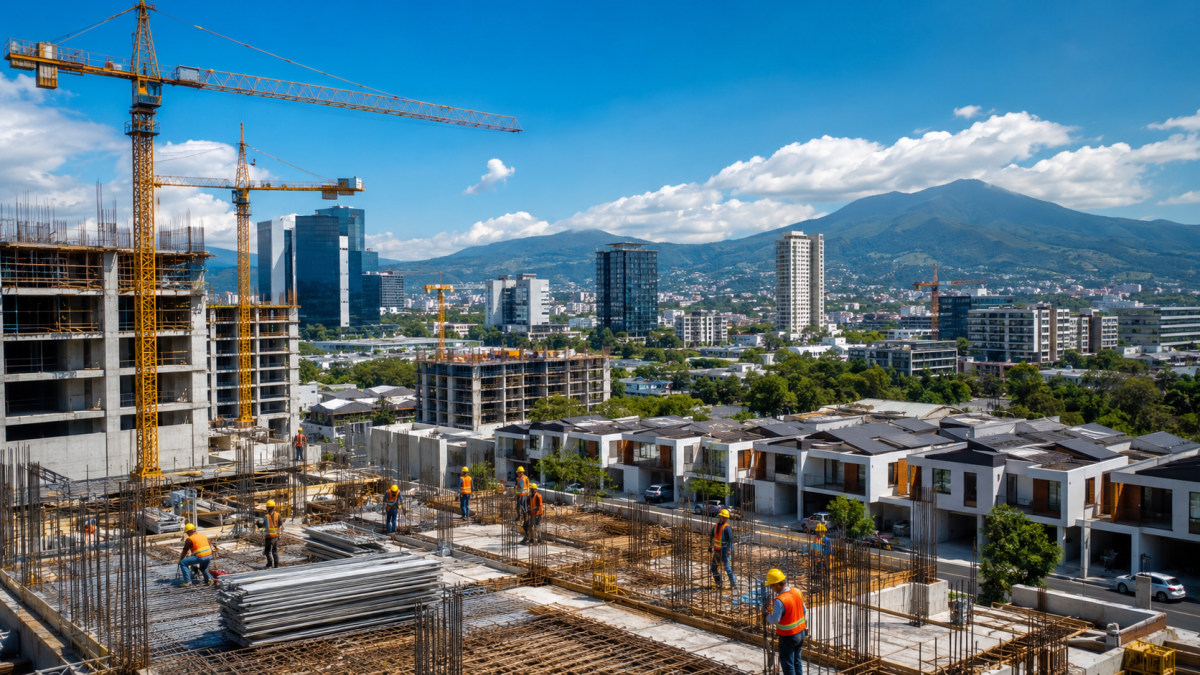
Across El Salvador, change is becoming increasingly visible. New homes, commercial developments, roads, public buildings, logistics centers, and major infrastructure projects are reshaping both the capital and communities beyond it.
Behind that activity is one of the strongest construction performances in Central America.
According to data from the Executive Secretariat of the Central American Monetary Council (SECMCA), El Salvador’s construction sector recorded year-on-year growth of 18.5% through April 2026. That placed the country at the top of the regional ranking and well ahead of most neighboring economies.
This is more than another encouraging statistic. Construction requires planning, financing, materials, workers, transportation, permits, and confidence that tomorrow will offer enough stability to justify investing today.
When all those pieces begin moving together, they tell us something important about a country’s direction.
El Salvador Establishes a Clear Regional Lead
The regional figures presented by SECMCA show a noticeable difference between El Salvador and the rest of Central America:
- El Salvador: 18.5%
- Nicaragua: 11.9%
- Costa Rica: 1.5%
- Honduras: 0.7%
- Guatemala: Updated 2026 figures were not available
Nicaragua posted a respectable result, but El Salvador’s rate was still approximately 55% higher. The difference becomes even more striking when compared with Costa Rica and Honduras, where construction activity remained nearly flat.
That does not mean every construction project is the same or that each country faces identical economic conditions. It does, however, show that El Salvador has developed unusually strong momentum within one of the economy’s most important industries.
What Is Driving the Construction Boom?
Buildings do not rise simply because a government announces a new policy or because a developer purchases a piece of land. Construction expands when investors believe projects can move forward, customers believe they can make long-term commitments, and businesses see enough opportunity to risk their capital.
Luis Rodríguez, executive director of the Office of Planning for the Metropolitan Area of San Salvador, or OPAMSS, has connected the sector’s performance to stronger cooperation between public institutions and private enterprise.
“Continuing to lead construction growth in the region is only possible through alliances between the public and private sectors,” Rodríguez said, adding that the boom is helping position El Salvador as a development hub in Central America.
That cooperation matters. Private developers need efficient approval processes and clear rules. Government agencies need responsible businesses that will create jobs, comply with safety requirements, and contribute to organized urban development.
Neither side can transform the country alone.
Security Has Changed the Investment Conversation
Housing Minister Michelle Sol has also emphasized the role of national security and investor confidence in the sector’s expansion.
“El Salvador leading construction growth in Central America is not a coincidence,” she said. “It is the result of a clear vision, of generating confidence for investment, and above all, of the security achieved thanks to the president’s decisions.”
For years, insecurity affected nearly every part of life in El Salvador. It influenced where people could live, where businesses could operate, how construction workers traveled, and whether investors were willing to invest in certain communities.
When companies feared extortion, theft, or territorial restrictions, even a promising project could become too risky. Those conditions did not only hurt large corporations. They affected contractors, hardware stores, transportation companies, architects, engineers, equipment operators, and ordinary laborers.
Today, the investment conversation is changing.
Projects that once appeared uncertain are moving forward. Communities previously overlooked by developers are receiving greater attention. Businesses can plan with greater confidence that their workers, materials, and property will be protected.
Security alone cannot build an economy, but economic confidence is difficult to sustain without it.
Construction Leads a Broader Economic Expansion
The building boom is not taking place in isolation.
El Salvador also led growth in overall economic activity in the Central America and the Dominican Republic region during April 2026. The country recorded a year-on-year increase of 5.78%, placing it ahead of Guatemala, Costa Rica, Honduras, and Nicaragua, according to the regional figures.
That broader performance suggests construction is part of a larger acceleration rather than a temporary surge limited to one industry.
The Central Reserve Bank reported that El Salvador’s gross domestic product grew by 4.8% during the first quarter of 2026 compared with the same period of 2025. GDP reached approximately $9.26 billion, an increase of more than $604 million.
Construction was the country’s most dynamic economic activity during the quarter, expanding by 13.5%. It was followed by mining and quarrying at 11.1% and transportation and storage at 7.6%. Hotels and restaurants also performed strongly, growing by 7.1%.
Seventeen of the 19 economic activities measured by the BCR posted positive results. Together, those growing sectors represented more than 80% of national GDP.
These figures show that the country’s progress is becoming more widely distributed across the economy.
Public and Private Projects Are Moving Together
The BCR attributed construction’s strong first-quarter performance to a mixture of private and public investment.
Housing, commercial buildings, and logistics developments have attracted private financing. At the same time, the government continues to invest in roads, schools, airports, public facilities, and other infrastructure.
One of the most visible examples is the Pacific International Airport, a strategic project intended to improve connectivity and bring new economic opportunities to eastern El Salvador.
Public works of this scale can produce benefits far beyond the construction site. Better roads reduce transportation time. Modern airports improve access to markets. New schools support education. Logistics facilities help companies move products more efficiently.
Private projects have a different but equally important role. Residential construction responds to housing demand, while offices, hotels, stores, warehouses, and industrial developments support business expansion.
When both forms of investment grow together, they can reinforce one another. Public infrastructure makes private development more attractive, while expanding businesses increase demand for improved services and transportation.
One Project Supports Many Different Jobs
Construction is sometimes measured by the number of permits issued, square meters built, or dollars invested. Those measurements are important, but they do not show the full human impact.
A single development may employ architects, engineers, electricians, plumbers, welders, masons, carpenters, painters, machine operators, truck drivers, security personnel, and administrative workers.
The project also creates demand for cement, steel, glass, lumber, electrical supplies, plumbing materials, paint, tools, fuel, food, transportation, and professional services.
This is why construction can become such a powerful economic engine. Money invested in a building does not remain inside its walls. It moves through a wide network of businesses and households.
The BCR noted that the sector’s expansion increased demand for labor, materials, transportation, and professional services, strengthening activity in other parts of the economy.
For a small supplier, a new contract can mean the ability to hire another employee. For a construction worker, steady employment can provide greater security for a family. For a young Salvadoran learning a skilled trade, the industry can offer a future without leaving the country in search of opportunity.
Housing Must Remain Part of the Story
Minister Sol correctly pointed out that every project can help bring the dream of homeownership closer to Salvadoran families.
That is an important goal, but it is also where the country must remain focused.
Luxury apartments, commercial towers, hotels, and large developments are signs of investor confidence. However, the true measure of progress will include whether working families can find safe, decent, and affordable housing.
The construction boom creates an opportunity to address long-standing housing needs. That will require cooperation among government institutions, private developers, banks, community organizations, and the families hoping to purchase or improve a home.
Economic growth should not only change skylines. It should improve neighborhoods and expand opportunities for people at different income levels.
A strong construction industry gives El Salvador the tools to pursue both goals.
Growth Must Be Planned Responsibly
Rapid development also brings responsibilities.
Cities must consider traffic, drainage, access to water, waste management, green spaces, public transportation, and the ability of local services to support a growing population. Poorly planned construction can create problems that last for decades.
OPAMSS and municipal authorities therefore have an important role. Faster permit processing can encourage investment, but speed must not replace proper oversight.
El Salvador needs modern development that respects safety standards, protects the environment, and fits into a wider vision for each community.
The goal should not be to build everywhere simply because investment is available. It should be about building wisely, creating places that will continue to serve Salvadorans long after the current boom has passed.
Can El Salvador Exceed the 2026 Forecast?
SECMCA has projected that El Salvador’s economy could grow between 3% and 3.5% by the end of 2026.
With GDP already expanding by 4.8% during the first quarter and construction continuing to lead the region through April, there is reason for optimism. However, one strong quarter does not guarantee the final result.
Global trade conditions, energy costs, interest rates, commodity prices, extreme weather, and developments in the United States can still influence El Salvador’s performance.
Even so, the country enters the second half of 2026 with encouraging momentum. Public investment remains active, private developers continue to announce projects, and infrastructure improvements are creating new possibilities for commerce, tourism, housing, and logistics.
The challenge now is to maintain that progress without losing sight of affordability, transparency, environmental protection, and the needs of ordinary Salvadorans.
What These Numbers Mean for Salvadoran Families
Economic reports can sometimes feel distant from daily life. Percentages and regional rankings may sound impressive, but people naturally want to know what they mean at home.
In practical terms, a growing construction sector can mean:
- More jobs in skilled trades and general labor
- Additional business for local suppliers and contractors
- Greater demand for transportation and professional services
- New homes and residential communities
- Improved roads, schools, airports, and public facilities
- Expanded opportunities for young people to learn technical skills
- Increased commercial activity in developing areas
Not every family will experience those benefits immediately. Progress rarely reaches every community at the same speed. Still, the economic connections created by construction are broad, and the potential impact extends far beyond developers and property owners.
People can see this kind of growth. They see it in cranes above the capital, road crews working across the country, new businesses opening, neighborhoods expanding, and projects beginning in areas where little investment once occurred.
A Country Building More Than Structures
El Salvador’s 18.5% construction growth is an important achievement, but the larger story is about confidence.
It reflects businesses willing to invest, institutions working to modernize, laborers finding employment, and communities preparing for new possibilities.
The country is building homes, roads, airports, businesses, and public facilities. At the same time, it is building a reputation as a place where projects can advance, and long-term plans can become real.
There is still much work ahead. Housing must remain affordable. Development must be organized. Public resources must be used responsibly, and the benefits of expansion must reach communities throughout the country.
Those are not reasons to dismiss the progress. There are reasons to manage it carefully.
For now, El Salvador stands at the top of Central America’s construction ranking, supported by one of the region’s strongest rates of overall economic activity. That position represents more than concrete and steel.
It represents jobs, movement, opportunity, and a growing belief in the country’s future.
El Salvador is not simply building new structures. It is building momentum—and people across the region are beginning to notice.
If you enjoy stories about El Salvador’s development, economy, tourism, culture, and continuing transformation, please consider liking, commenting, and sharing this article.
Leave a Reply