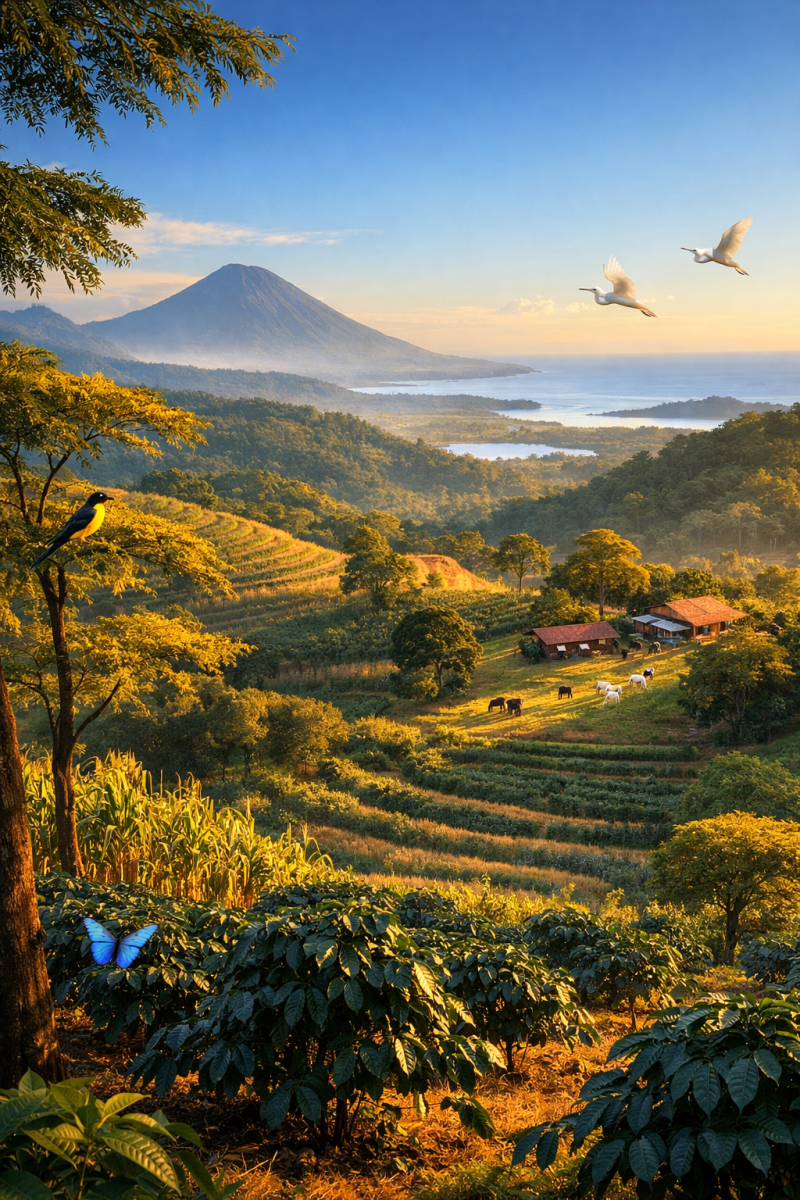

Across El Salvador’s hillsides, coffee farms, grazing lands, and coastal communities, another kind of progress is taking root.
It does not always arrive with ribbon cuttings or large construction projects. Sometimes it comes quietly, through shade trees planted beside crops, healthier soil, restored watersheds, and farmers who begin to see their land as part of a living system.
That is why the work of FIAES deserves more attention.
The Fondo de Inversión Ambiental de El Salvador, known as FIAES, has become one of the important names in the country’s environmental and rural development story. Its work connects conservation, agriculture, water protection, biodiversity, and local livelihoods in a way that feels practical rather than theoretical.
In a country as small and densely populated as El Salvador, this matters deeply.
What FIAES Is and Why It Matters
FIAES stands for Fondo de Inversión Ambiental de El Salvador, or El Salvador’s Environmental Investment Fund.
It is not a traditional ministry, nor is it simply another nonprofit organization. Its role is different. FIAES works as a financial and coordinating platform that brings together resources, technical support, public institutions, international partners, and local organizations.
Those resources are then directed toward real projects on the ground.
Through this model, money that may begin as international cooperation, environmental compensation, or debt-for-nature financing can become something visible in a Salvadoran community: trees planted, soil protected, coffee farms improved, mangroves restored, rivers cared for, and rural families trained in more sustainable practices.
That connection between global financing and local action is one of the reasons FIAES has become so relevant.
Productive Landscapes With a Purpose
One of the clearest examples is the Programa de Paisajes Productivos, or Productive Landscapes Program.
According to recent reporting from Diario El Salvador, between 2020 and 2025, FIAES implemented 62 projects that helped restore or improve more than 9,730 hectares across the country.
Those efforts included agroforestry systems, silvopastoral practices, and forest restoration.
The work reached strategic territories such as El Imposible, Barra de Santiago, Apaneca–Ilamatepec, Tecapa–Chinameca, Golfo de Fonseca, Nahuaterique, and Cerrón Grande.
This is not a small achievement.
In practical terms, these are areas where agriculture, water, forests, wildlife, and rural families meet. They are places where environmental damage does not remain isolated. When soil erodes, harvests suffer. When watersheds weaken, communities feel the effect. When forests disappear, biodiversity loses its home and farmers lose natural protection against heat, drought, and heavy rain.
The Productive Landscapes Program recognizes that reality. It does not treat conservation and farming as opposing forces. Instead, it brings them together.
Agriculture That Produces and Protects
For many Salvadoran families, the land is not an abstract environmental issue. It is food, income, inheritance, and daily survival.
That is why any serious environmental strategy in El Salvador must include farmers. The country cannot protect nature by ignoring the people who work the soil. It has to build solutions with them.
This is where agroforestry and silvopastoral systems become so important.
Agroforestry combines crops with trees, fruit species, and other vegetation. A coffee finca, for example, can provide income while also maintaining shade, protecting soil, supporting birds, and creating habitat for pollinators.
Silvopastoral systems bring trees into livestock areas. Instead of bare pastures exposed to sun and erosion, cattle graze in spaces that offer shade, improved grasses, better soil structure, and more ecological balance.
These methods are not just environmental ideals. They are practical tools.
They help conserve moisture in the ground. They reduce erosion. They improve fertility. They support wildlife. They can also make rural production more resilient when the climate becomes unpredictable.
A parcel of land, then, becomes more than a place to grow maize, coffee, fruit, or pasture. It becomes part of a wider living network.
The Human Side of Restoration
Numbers are important, but they only tell part of the story.
FIAES-linked efforts have generated more than 1,400 jobs and created around 350,000 jornales, or day-labor opportunities. In coffee-growing areas, family incomes reportedly increased by about $360 per hectare per year.
For a small producer, that additional income can carry real meaning.
It may help a family keep children in school. It may provide money for better seeds, tools, or repairs. It may reduce the pressure to clear more land. It may also give a household a little more breathing room when drought, storms, pests, or market changes create uncertainty.
That is the part of environmental work people sometimes overlook.
Restoration is not only about trees. It is also about stability. It is about giving rural families better options so they can care for the land without sacrificing their own future.
Biodiversity Returns When Land Is Given a Chance
The environmental benefits are also measurable.
Monitoring connected to these projects has identified 46 tree species in restored areas. More than 90 species of birds, reptiles, and mammals have also been recorded, including both resident and migratory wildlife.
That tells us something encouraging.
When land receives attention, life begins to return. Birds move through shaded corridors. Insects pollinate. Trees rebuild soil. Water filters more naturally. Wildlife finds places to feed, nest, and move.
This is why the word “landscape” matters.
A productive landscape is not only a farm. It is a mosaic of crops, trees, animals, water, people, and natural processes. Each part affects the others.
When that balance improves, the countryside becomes stronger.
Debt-for-Nature and International Cooperation
Another important part of FIAES’s story is its role in connecting El Salvador to international environmental finance.
Debt-for-nature mechanisms convert portions of debt or savings from financial arrangements into long-term conservation funding. Instead of treating debt only as a burden, these tools create room for investment in forests, watersheds, biodiversity, and community resilience.
FIAES has experience managing this type of work. It has been linked to mechanisms such as TFCA, TFCCA, and the Iniciativa para las Américas, along with other conservation and environmental funding sources.
This matters because El Salvador faces environmental challenges that require consistent financing, not temporary enthusiasm.
Planting a tree is one step. Maintaining it, protecting the surrounding land, training farmers, monitoring results, and building local participation are longer commitments.
FIAES helps make that long-term approach possible.
A Different Kind of Development
When people talk about development, they often think first of roads, buildings, airports, housing, or investment projects. Those things matter, and El Salvador has seen many visible changes in recent years.
But development can also mean healthier soils.
It can mean cleaner water.
It can mean shade over a coffee farm, stronger mangroves along the coast, better pasture for cattle, and a hillside that no longer washes away during heavy rain.
For rural communities, that kind of progress is not symbolic. It is practical and personal.
A family that improves its land improves its future. A watershed that recovers protects more than nature; it supports drinking water, agriculture, and local economies. A restored forest patch may look small on a map, but it can become part of a larger chain of life.
That is why FIAES matters.
It shows that environmental work does not have to be separated from economic growth. Done properly, the two can support each other.
Why This Work Is Important for El Salvador’s Future
El Salvador has very little room for environmental neglect.
The country is small. Its population is dense. Its rivers, forests, volcanoes, coastlines, and farming areas are all closely connected. Damage in one place can quickly affect another.
Deforestation, erosion, water stress, and climate pressure are not distant concerns. Many communities already understand them from experience.
That makes programs like Paisajes Productivos especially valuable.
They help rural areas move away from exhaustion and toward regeneration. They encourage farmers to protect what they depend on. They bring science and tradition together. They also remind the country that the countryside is not backward or forgotten. It is central to El Salvador’s future.
A nation cannot be truly strong if its land is weak.
A Closing Reflection
When we hear that more than 9,730 hectares have been restored or improved, it is easy to let the number pass by as just another statistic.
But behind that figure are real places.
There are hillsides where bare soil can once again hold roots. Coffee farms where shade trees protect both crops and wildlife. Pastures where cattle graze under timber and fruit species. Coastal and watershed communities where people are learning to see their surroundings not as something to exhaust, but as something to inherit, protect, and pass on.
That is the deeper meaning of FIAES.
It is an investment in nature and in the relationship between Salvadoran families and the land that sustains them.
And in the long story of El Salvador’s transformation, that quiet work may prove to be one of the most important changes of all.
If you enjoy stories about El Salvador’s culture, development, tourism, history, and transformation, please consider liking, commenting, and sharing this article.
And if you are drawn to true-life stories that explore how experience shapes the soul — confronting reality, searching for meaning, and discovering the quiet spiritual guidance that helps us endure — you may find resonance in my memoir, Harmony of the Cosmos, available now on Amazon.

View Harmony of the Cosmos on Amazon

Consigue la edición en español en Amazon:
Edición en español en Amazon
Leave a Reply