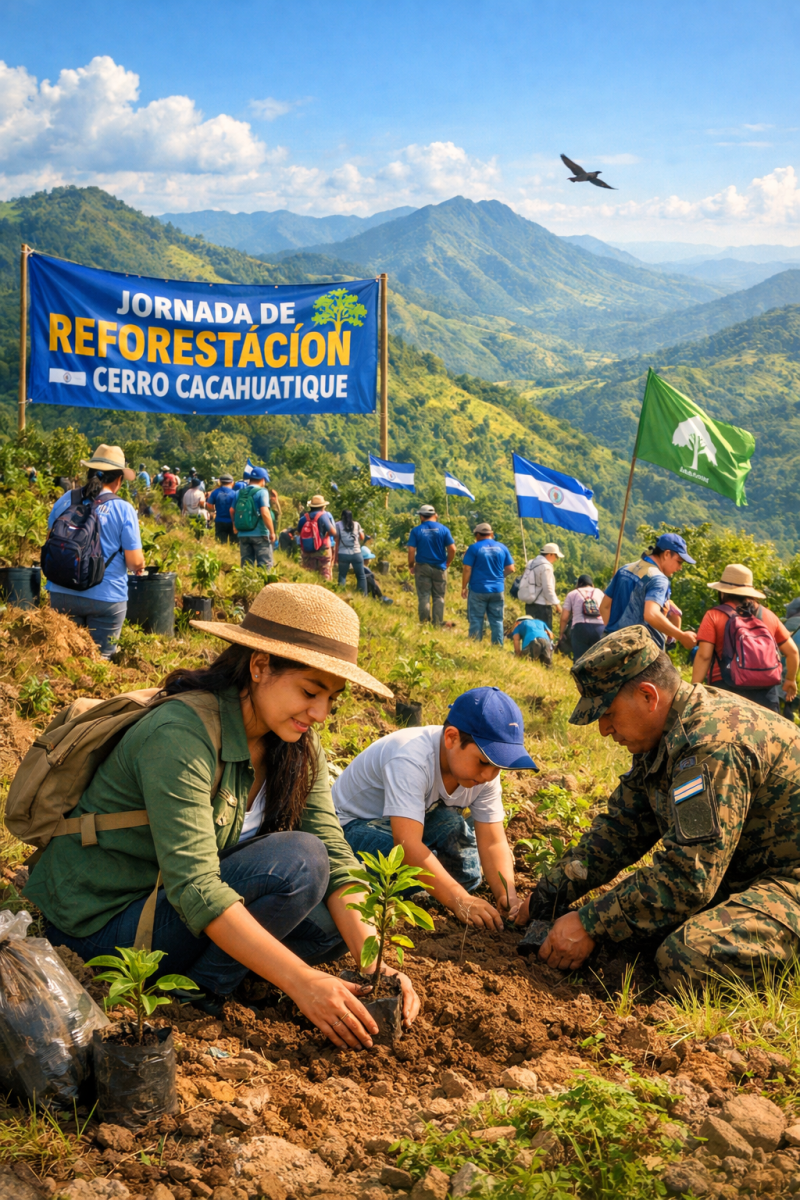
Cerro Cacahuatique began the week with the sound of footsteps, voices, and the quiet determination of people who understand what it means to care for a mountain.
In the district of Osicala, Morazán Sur, municipal workers, community organizations, students, water boards, and other institutions gathered for a reforestation day in one of eastern El Salvador’s most important water-recharge areas.
This was not simply a ceremonial planting or an opportunity to take photographs beside a few young trees. The activity forms part of a larger reforestation plan with an ambitious goal: planting 30,000 trees during the rainy season.
That number matters. However, the real importance of this project is not found only in the number of seedlings placed in the ground. It is found in the water that those trees may help protect the soil they may hold in place, and the communities that will depend on that mountain long after the planting crews have gone home.
A Mountain That Sustains Communities
Cerro Cacahuatique is much more than a beautiful geographic feature on a map of Morazán.
Its springs, forests, and micro-watersheds help supply water to communities in Chilanga, San Francisco Gotera, San Carlos, Yamabal, and other areas extending into northern San Miguel. Studies of the region have found that many residents depend on water sources located along the mountain’s slopes.
In that sense, the mountain serves as a natural reservoir.
Rain falls across its slopes and filters into the soil. Forests slow the movement of water, reduce erosion, and help the ground retain moisture. Springs and streams then carry that water toward the communities below.
When trees disappear, the natural system weakens.
Bare or damaged soil cannot hold water as effectively. Heavy rain runs quickly down the slopes, carrying valuable soil with it. Streams can fill with sediment, while springs may produce less water during the dry season. The damage may begin high on the mountain, but families living many kilometers away eventually feel the consequences.
This is why reforestation on Cacahuatique is not only an environmental project. It is an investment in water security, agriculture, and the daily lives of thousands of Salvadorans.
A Responsibility Shared by Many
One of the most encouraging parts of this effort is the number of groups working together.
The reforestation day included representatives from the municipal government, the Departmental Government of Morazán, PADECOMS, Lutheran World Relief, ASPS, ACUGOLFO, the Armed Forces, local water boards, Civil Protection commissions, and other community participants.
Each organization may approach the mountain from a different perspective. Some focus on water. Others work in agriculture, community development, health, emergency response, education, or local government. On this day, however, they shared one purpose: protecting the landscape that supports the entire region.
That cooperation is important because environmental restoration cannot succeed through the work of a single institution.
A government agency may provide trees. Municipal workers may prepare the land. Community organizations may identify the areas facing the greatest risk. Water boards understand which springs and systems are most vulnerable. Farmers know where erosion is damaging their soil. Residents provide the long-term care that young trees need after the official event has ended.
When these groups work together, reforestation becomes more than a one-day activity. It becomes part of a larger commitment to the territory.
Students Learning Through Their Hands
Students from the National Institute of Osicala also participated in the reforestation effort. Their presence added another level of meaning to the day.
Young people can learn about forests, climate, and water conservation in a classroom. Those lessons are important, but there is something different about placing a seedling into the soil with your own hands.
A student who plants a tree may return years later and see that it has grown taller than they are. They may remember the morning they carried it up the slope, covered its roots, and gave it its first water.
That experience creates a personal connection with the land.
It teaches that environmental care is not an abstract idea reserved for experts or government officials. It is something ordinary people can practice. It also reminds young Salvadorans that the future of their communities will eventually become their responsibility.
The trees planted during this rainy season may still be standing when today’s students are raising families of their own.
Reaching Beyond Cerro Cacahuatique
The broader reforestation plan will not be limited to a single area of the mountain.
Trees are also expected to be distributed to places damaged by fires, other water-recharge zones, and properties where farmers and producers want to conserve their soil and restore degraded land.
This broader approach makes sense.
Environmental damage rarely remains within a single boundary. Fire, erosion, deforestation, drought, and poor land management affect entire watersheds. Restoration must therefore extend across hillsides, farms, forests, and communities.
A tree planted on agricultural land can help hold the soil together. Trees placed near a spring can provide shade and protection. Reforestation in a fire-damaged area can begin to restore habitat and reduce future erosion.
No single planting campaign can repair every damaged landscape. However, progress often begins this way—one hillside, one farm, one community, and one rainy season at a time.
Planting Is Only the Beginning
Reaching the goal of 30,000 trees would be a significant achievement, but planting them is only the first step.
Young trees need protection. Some will require water when rainfall becomes irregular. Others may need barriers to prevent livestock from damaging them. Communities must watch for fires, illegal cutting, pests, and other threats.
Survival matters more than the number planted during the opening campaign.
A seedling placed in the ground and forgotten may not live through its first dry season. A tree monitored and protected by the community has a much better chance of becoming part of the forest.
That is why the participation of local residents, students, farmers, and water boards is so valuable. Institutions can begin a project, but the people who live around the mountain will ultimately determine whether it succeeds.
Real restoration takes patience. Forests do not return overnight, and damaged water systems do not recover after a single rainy season. The work may take years, but every mature forest began with young trees taking root.
A Quiet Form of National Progress
When we speak about El Salvador’s transformation, most attention naturally goes toward visible projects: new roads, hospitals, schools, tourism centers, airports, markets, and public spaces.
Those developments matter. They are signs of movement and investment.
Environmental recovery is often quieter.
It happens on a mountain slope far from the capital. It happens when community members protect a spring, when farmers change the way they manage their land, or when students spend a morning planting trees instead of sitting behind their desks.
There may be no ribbon cutting when a hillside slowly becomes green again. Yet the benefits can last for generations.
Protecting Cerro Cacahuatique means protecting part of El Salvador’s natural infrastructure. The mountain collects water, supports agriculture, provides habitat, and helps communities face the increasing uncertainty of drought, irregular rainfall, and extreme weather.
That work deserves the same seriousness we give to concrete, steel, and public construction.
Caring for a Place We May Never See
Those of us living in western El Salvador may be far from Morazán, but projects like this still matter to us.
Our country is small, and its environmental systems are connected. The mountains, forests, rivers, wetlands, and coastal areas may belong to different regions, but together they sustain the nation.
What happens on Cerro Cacahuatique affects the families who turn on a faucet, fill a water container, irrigate a crop, or depend on a community water system. Their concerns may be local, but the lesson belongs to all of us.
Water does not appear by accident. It comes from landscapes that must be respected, managed, and protected.
The people planting trees in Osicala are caring for something they may never personally own. They are working for neighbors they may never meet and for children who have not yet been born.
There is something deeply hopeful in that.
A Promise Planted in the Soil
A reforestation day may seem small when compared with the size of a mountain. A single seedling may appear fragile beneath the surrounding trees.
Yet every restored forest begins with such a moment.
Someone carries a young tree to the right place. Someone opens the soil. Someone covers its roots and trusts that the rain will help it grow.
Years later, that tree may provide shade, hold back erosion, shelter wildlife, or help water filter into the earth. The person who planted it may never see its full height, but the community may still receive its benefits.
Un árbol plantado en silencio puede cambiar el futuro de una comunidad.
A tree planted today is a promise kept for the generations that follow.
Cerro Cacahuatique gives water to its communities. By caring for the mountain, those communities are now giving something back.
If you enjoy stories about El Salvador’s development, economy, tourism, culture, environment, and continuing transformation, please consider liking, commenting, and sharing this article.
Leave a Reply