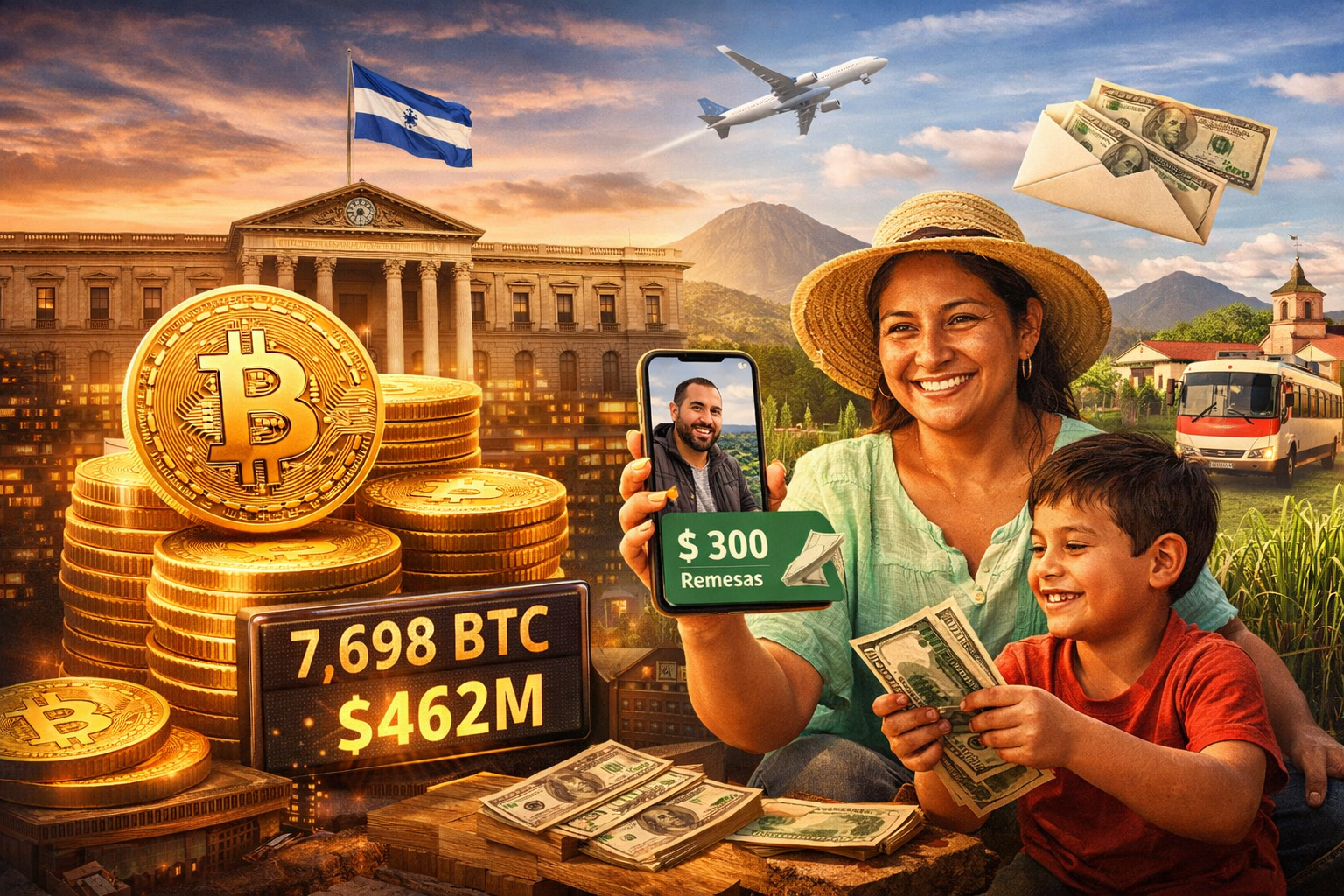
Two reports landed in the same news cycle this week, and together they tell a much larger story about El Salvador.
One report focuses on the government’s bitcoin reserve — a national holding that continues to grow inside a public wallet. The other looks at remittances sent through cryptocurrency wallets, where families abroad use digital tools to send money home.
At first glance, these may seem like two separate stories. One belongs to the world of national policy, international finance, and sovereign strategy. The other belongs to ordinary families, monthly expenses, and the practical need to move money across borders.
But here in El Salvador, both stories matter.
They share the same country. They share the same technology. And they both raise a question that has followed El Salvador since bitcoin first became part of the national conversation:
What is Bitcoin really for?
The Numbers Behind the Story
According to recent figures from El Salvador’s Banco Central de Reserva and the Oficina Nacional del Bitcoin, two trends are moving at the same time.
From January through May 2026, remittances received through cryptocurrency wallets reached $29.25 million. That represents a 41.8 percent increase compared with the same period in 2025, when the figure was $20.63 million. The number of transactions also increased to 94,530, while the average amount sent rose from $266.50 to $309.43.
Those numbers suggest that crypto remittances are becoming more active again, even after the country stepped away from the more public part of its bitcoin experiment.
At the same time, El Salvador’s sovereign bitcoin reserve has reportedly reached 7,698 coins. At a bitcoin price of roughly $60,000, that reserve would be valued at approximately $462 million.
These two numbers tell very different stories.
One is about a national reserve. The other is about families sending money home.
One is shaped by government policy. The other is shaped by daily necessity.
The National Reserve: A Long-Term Bet
El Salvador’s bitcoin reserve is a top-down project. It is deliberate, institutional, and tied to the government’s belief that bitcoin may become more valuable over time.
President Nayib Bukele’s administration began purchasing bitcoin several years ago and has continued to defend the strategy through both criticism and market volatility. The idea is similar to what investors call dollar-cost averaging: buying steadily over time rather than trying to predict the perfect moment.
Supporters see this as bold and visionary. They argue that El Salvador positioned itself early in financial technology, which could grow in importance over the coming years. They also see the reserve as part of a larger effort to place the country on the global map for innovation, investment, and independence.
Critics see something very different. They worry about volatility, transparency, and the risk of placing public resources into an asset that can rise or fall sharply. For a small country with many urgent needs, those concerns should not be dismissed.
That is the reality of the Bitcoin reserve. It is not an everyday tool for most Salvadorans. It is a national bet made on behalf of the country.
Whether it becomes a wise decision or a costly one will depend on forces far beyond El Salvador’s control.
The Remittance Story Is Different
The remittance story feels much closer to daily life.
When someone in Los Angeles, Houston, Washington, New York, or Virginia sends money home through a cryptocurrency wallet, that person is usually not trying to make a political statement. They are not thinking about sovereign reserves or international headlines.
They are looking for a transfer that costs less, arrives faster, and gives them confidence that the money will reach the people waiting for it back home — parents, spouses, children, grandparents, or relatives who depend on that support.
That is a very different kind of decision.
For many Salvadoran families, remittances are not extra money. They are part of the household economy. They help pay for food, medicine, school supplies, building materials, transportation, and small improvements to family homes.
A few dollars saved on each transfer may not sound like much to someone reading a financial report. But when money is being sent month after month, those savings can matter.
For a family operating on a tight budget, lower transfer costs are not a theory. They are real.
A Practical Use for a Complicated Technology
Bitcoin and cryptocurrency can sound complicated, especially for people who do not use digital wallets or follow financial markets. For many Salvadorans, the early bitcoin rollout felt confusing, rushed, or disconnected from their daily reality.
That may be one reason the original Chivo wallet experiment struggled to become part of ordinary commerce. Many people received the sign-up bonus, but that did not mean bitcoin became a normal part of their lives.
Buying pupusas, paying for groceries, or taking a bus does not require a national technology experiment. People use what is simple, familiar, and trusted.
But remittances are different.
A money transfer already involves distance, fees, waiting, identification, and trust in a service provider. If a digital wallet can reduce costs and get money to arrive faster, some families will try it — not because they are loyal to bitcoin, but because it solves a practical problem.
That may be the most important lesson here.
Technology does not become useful because a government announces it. It becomes useful when ordinary people find a reason to keep using it.
The Chivo Chapter Has Changed
El Salvador’s bitcoin story has already changed since 2021.
The country made global headlines when bitcoin became legal tender. Businesses were expected to accept it; the Chivo wallet was introduced, and El Salvador became a symbol in the worldwide debate over cryptocurrency.
For some, that moment was exciting. For others, it was unsettling.
Over time, public use remained limited. Many Salvadorans continued to prefer the U.S. dollar for daily transactions. Surveys repeatedly showed that most people were not using bitcoin in everyday commerce.
Then came the agreement with the International Monetary Fund. As part of that process, bitcoin acceptance became voluntary, its status as legal tender was removed, and the government began moving away from direct participation in the Chivo wallet system.
That means the public-facing experiment has been reduced.
But it has not disappeared completely.
The state continues to hold bitcoin. Families continue to use digital channels for some remittances. The experiment is no longer the same one announced in 2021, but it is still alive in a different form.
Ahuachapán and the Local Picture
One detail in the remittance data stands out for those of us living in western El Salvador.
Ahuachapán recorded the highest interannual remittance growth among departments during the January-to-May period, up 8.5 percent from last year.
That deserves attention, but also caution.
A high percentage increase does not automatically mean a department is becoming wealthy. Growth from a smaller base can produce strong percentages. Ahuachapán still faces many economic challenges, especially in rural areas where opportunity can be limited.
But the direction is meaningful.
Families connected to this region are sending more money home. That tells us something about the strength of the Salvadoran diaspora and the continuing importance of family ties across borders.
Living here, you notice this before you read it in a report.
You can see it in small but meaningful ways: a new roof on a family home, a tienda with full shelves, an extra room added little by little, a child staying in school, medicine purchased on time, a porch finally finished, or a small business making it through another month.
Not all of that comes from remittances, of course. People here work hard, save carefully, and build slowly. But remittance money is part of the quiet foundation underneath many communities.
It may not attract the same headlines as a bitcoin reserve, but it touches daily life in a much more direct way.
The Diaspora Remains an Economic Lifeline
El Salvador’s economy is deeply connected to its people abroad.
Millions of Salvadorans and Salvadoran descendants live outside the country, especially in the United States. They work in restaurants, construction, cleaning, transportation, factories, offices, landscaping, caregiving, and countless other jobs.
Every month, part of that income comes back home.
Those dollars are not abstract. They are a sacrifice.
They represent long hours, distance from family, and the responsibility many migrants continue to carry even after building lives elsewhere.
This is why remittances should always be discussed with respect. Behind every transfer is a human story — money earned through long hours, sent with care, and received by someone here who was counting on it.
Whether the transfer arrives through a bank, Western Union, a digital provider, or a cryptocurrency wallet, the purpose is usually the same: to support family.
That is the human side of the remittance economy.
Two Uses for the Same Technology
What we are seeing now is not one bitcoin story, but two.
The government sees bitcoin as a strategic asset — something to hold, accumulate, and possibly benefit from in the future.
Families using crypto remittances see it differently. For them, it is not about ideology or national branding. It is a tool. If it is cheaper, faster, and more reliable, it has value.
Those two uses do not always align.
A government reserve is about long-term positioning. A family transfer is about immediate need.
A national wallet can be debated in financial terms. A remittance is judged by whether the money arrived and how much was lost in fees along the way.
This is why the remittance side may prove more durable than the original retail Bitcoin experiment. People may not want to use bitcoin to buy everyday goods, but they may still be willing to use digital channels when sending money across borders.
That distinction matters.
The Question of Trust
For any financial system, trust is everything.
People need to trust that their money will arrive. They need to trust the platform, the exchange rate, the fees, and the ability to convert funds into a usable form.
This is one reason digital adoption can be uneven. Younger people or those with family abroad may be more comfortable with wallets and apps. Older people may prefer cash, banks, or familiar transfer offices.
In rural El Salvador, trust often grows slowly. People may try something once, then decide based on the result. If it works, they may use it again. If it fails, they may never return to it.
That is another lesson from the Bitcoin experiment.
Adoption cannot be forced by publicity. It has to be earned through usefulness, reliability, and confidence.
A Balanced View Is Needed
There is no need to turn this discussion into a simple argument for or against Bitcoin.
The truth is more complicated.
The national reserve could become a valuable asset if Bitcoin rises over time. It could also lose value if the market turns sharply. That risk belongs to the country.
Crypto remittances may help some families save money on transfers. But they also require access, knowledge, trust, and systems that ordinary people can use without confusion.
Both realities can exist at the same time. It is possible to recognize bitcoin’s potential while still taking its risks seriously, appreciate lower remittance costs while asking for public accountability, and respect innovation while remembering that technology should serve people — not the other way around.
What This Means for Daily Life Here
For most people in El Salvador, the bitcoin reserve is distant. It exists in reports, government statements, and international headlines.
Remittances are different.
They are felt at the kitchen table. They show up in school uniforms, at doctor visits, in bags of cement, with groceries, and during family emergencies.
That is why the remittance numbers matter so much.
They reveal how deeply connected this country remains to its people abroad. They also show that Salvadorans will use new financial tools when they help solve real problems.
In the end, this may be where the most lasting part of the bitcoin experiment is found — not in the headlines, but in the quiet transfer of money from one family member to another.
Where Things Stand Today
As of June 30, 2026, the picture looks something like this:
El Salvador’s bitcoin reserve has reportedly reached 7,698 BTC, with an estimated value of about $462 million at current market prices.
Crypto remittances through May totaled $29.25 million, up 41.8 percent from the same period last year.
The number of crypto remittance transactions rose to 94,530.
Total remittances through May reached $4.2 billion, one of the highest five-month figures in recent records.
Ahuachapán recorded the strongest departmental remittance growth in the country, at 8.5 percent.
Bitcoin is no longer legal tender in the same way it was under the original law, and the Chivo wallet system is being wound down.
Yet the story continues.
The reserve remains.
Families keep sending.
And here in western El Salvador, where life moves among sugarcane fields, small towns, family homes, and the steady rhythm of daily survival, both sides of the experiment are unfolding simultaneously.
One belongs to the state.
The other belongs to the family.
And in the long run, it may be the family side that tells us the most about what this technology is really worth.
Final Thoughts
El Salvador’s bitcoin experiment has changed shape since 2021. It is no longer simply about legal tender, public wallets, or whether people will buy coffee with bitcoin.
It has become something more divided, and maybe more revealing.
At the top, Bitcoin remains a national bet.
At the household level, digital remittances remain a practical choice.
The first story will be judged by markets, transparency, and time.
The second will be judged by families — by whether money arrives faster, costs less to send, and helps someone live a little better.
That may not be as dramatic as a headline about a national bitcoin vault.
But for many Salvadoran families, it may matter more.
Sources: Banco Central de Reserva de El Salvador, Oficina Nacional del Bitcoin, International Monetary Fund, World Bank Open Data, Diario El Salvador, EFE, and other referenced financial data sources.
If you enjoy stories about El Salvador’s culture, development, tourism, and transformation, please consider liking, commenting, and sharing this article.
Leave a Reply