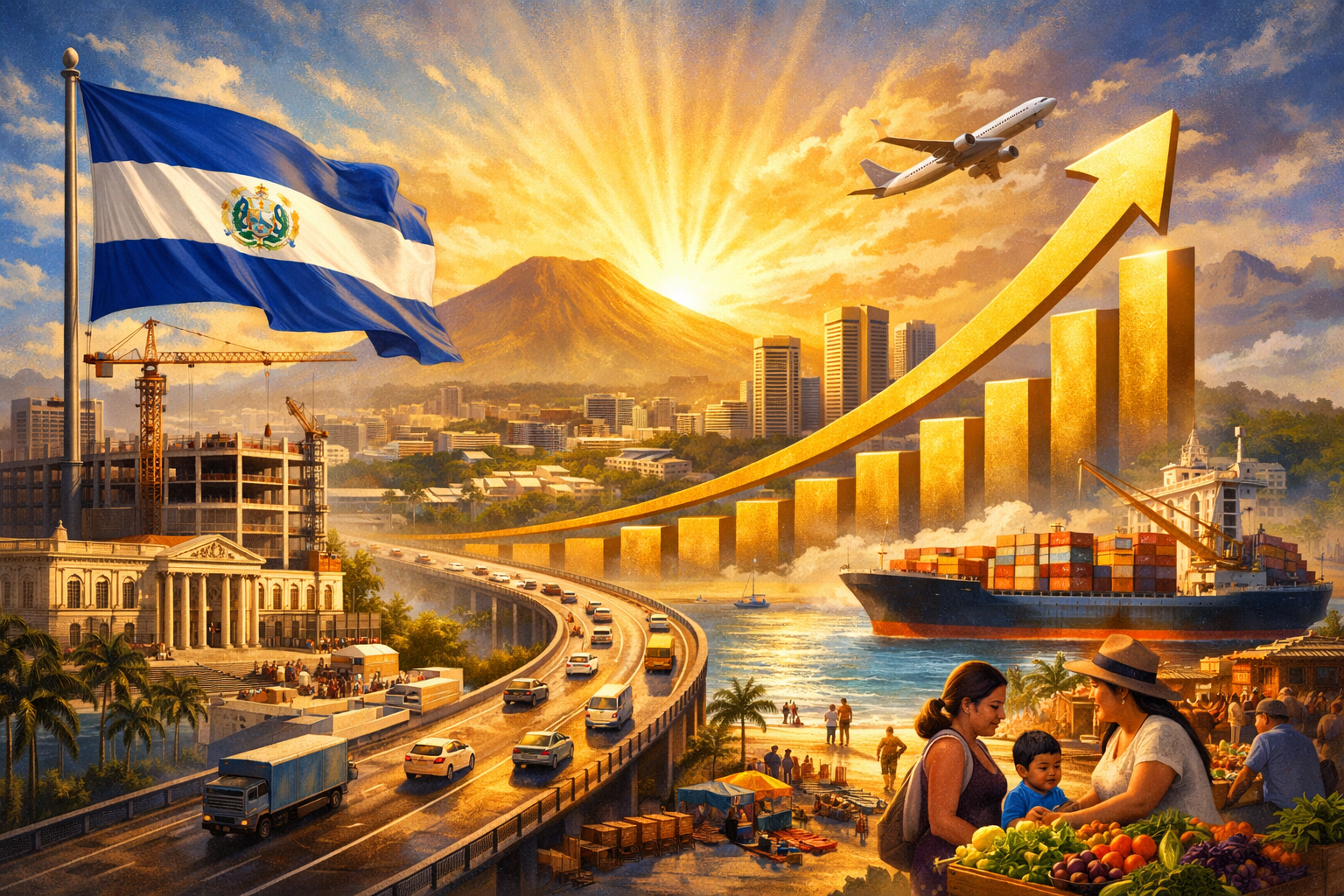
El Salvador began 2026 with a figure that deserves attention: the economy grew by 4.8% in the first quarter of the year.
For a country that spent many years moving at a slower pace, this figure stands out. It is not just another economic statistic. It suggests that something broader is happening across the country — in construction, tourism, trade, public investment, household income, and the everyday confidence people feel when they decide to build, spend, visit, invest, or open a small business.
For those of us living here, this growth does not feel distant. You can see it in the roads, markets, airports, coastal towns, construction sites, and the steady movement of people and goods.
Numbers matter, but in El Salvador, economic change is often felt before it is fully understood.
A Quarter That Broke the Pattern
According to the Banco Central de Reserva, El Salvador’s economy grew 4.8% in the first quarter of 2026.
That is a strong result by recent historical standards, especially since the growth was not limited to a single area. Seventeen of nineteen productive activities expanded, representing more than 80% of the economy.
That detail is important.
When only one sector grows, the result can be fragile. A tourism boom, a construction wave, or a temporary rise in exports can lift the numbers for a while, but the foundation may remain narrow. This quarter looked different. The expansion was spread across several areas, suggesting a more balanced form of momentum.
That does not mean every family feels the benefit equally. It does mean the economy is moving through more than one channel at the same time.
Construction Leads the Way
The standout sector was construction, which grew by 13.5%.
This is not hard to believe when you drive through different parts of the country. New housing projects are rising. Roads are being repaired or expanded. Commercial spaces are taking shape. Logistics centers, public works, and infrastructure projects are changing the physical landscape.
Construction matters because it does more than produce buildings. It creates jobs, moves materials, supports transportation, generates demand for hardware stores, and gives people visible proof that investment is happening.
New roads can shorten a commute.
A repaired school can improve daily life for students.
Housing projects can create work for masons, electricians, drivers, suppliers, and small food vendors in the area.
An airport or logistics investment can affect trade far beyond the project itself.
This is why construction often becomes one of the clearest signs of economic confidence. People do not build when they expect things to stand still. They build when they believe tomorrow may be stronger than yesterday.
Private and Public Investment Are Moving Together
The BCR attributed the construction surge to both private and public investment.
Private investment has been visible in housing, commercial development, and logistics projects. Public investment has focused on roads, schools, airports, and other infrastructure meant to support long-term growth.
That combination matters.
Private investment shows confidence from businesses, developers, and families. Public investment lays the foundation for more activity later. When the two move together, the effects can spread through the wider economy.
A country cannot grow only through announcements. It needs roads that work, schools that function, airports that move passengers efficiently, ports that support exporters, and communities where businesses can operate with less uncertainty.
El Salvador still faces challenges, but this quarter shows that investment is becoming one of the main drivers of the country’s economic growth.
Logistics and Trade Gain Strength
Another important part of the story is logistics.
El Salvador’s location gives it natural advantages, but geography alone is not enough. Goods need ports, customs systems, roads, airports, warehouses, and reliable transport. When those systems improve, exporters and importers feel the difference.
Recent investments at the San Óscar Arnulfo Romero International Airport and the Port of Acajutla are part of that bigger picture. They support the movement of goods, reduce bottlenecks, and help El Salvador position itself as a more serious logistics hub in the region.
Exports also grew, supported by industrial products, traditional goods, and services.
For a small country, export growth is important because it connects local production to foreign markets. It means Salvadoran products are competing abroad. It also supports jobs in manufacturing, agriculture, transportation, packaging, and services tied to trade.
When exports rise, the benefits are not limited to large companies. Small suppliers, drivers, warehouse workers, farmers, and service providers can all become part of the chain.
Tourism Continues to Reshape the Country
Tourism remains one of the most visible parts of El Salvador’s transformation.
In the first quarter of 2026, the country received around 1.3 million international visitors. Security improvements, international promotion, major events, and the growing popularity of destinations such as Surf City, Ruta de Las Flores, Suchitoto, Apaneca, and El Tunco have helped reshape the country’s image.
This is one of the areas where the change feels especially personal.
Years ago, many people abroad associated El Salvador mainly with violence, migration, and instability. Today, more visitors are coming to surf, explore volcanoes, visit colonial towns, enjoy coffee country, attend concerts, and experience a country they may have once avoided.
That shift affects real communities.
Restaurants fill tables.
Hotels hire staff.
Guides find work.
Artisans sell more.
Transportation services expand.
Small towns begin to see visitors not as a rare event, but as part of their future.
Tourism is no longer only seasonal. In some areas, it is becoming structural — part of how communities think about income, opportunity, and local identity.
Household Income Helped Drive Consumption
Economic growth also depends on families having money to spend.
During the first quarter, household income received support from two important sources: labor-related changes and remittances.
The Ley de la Quincena 25 gave many workers additional disposable income. Remittances also remained a powerful force, reaching approximately $2,435.6 million during the first three months of 2026.
That money matters.
Remittances are not just financial transfers. They are family lifelines. They help pay for food, medicine, education, home improvements, transportation, and emergencies. Many communities also support small businesses, construction projects, and local commerce.
When families have more income, they spend more in the local economy. That supports tiendas, markets, restaurants, hardware stores, transportation providers, and service businesses.
This is the quiet side of economic growth. It does not always appear in photos of airports or construction cranes, but it can be felt in a family’s ability to buy what they need, repair a home, or plan with a little more confidence.
Commerce, Restaurants, and Services Feel the Effect
When household income rises, the service economy often feels the impact quickly.
People buy groceries, eat out, travel, repair vehicles, purchase clothing, visit shopping centers, and spend on entertainment. Some of that spending is modest, but across millions of transactions, it becomes important.
This is why private consumption remains a major part of El Salvador’s economic story.
A family that has a little extra money at the end of the month may not think of itself as part of GDP growth. But every purchase contributes to economic activity.
A meal in a restaurant.
A bag of cement.
A school uniform.
A bus trip.
A hotel stay.
A repaired motorcycle.
A new refrigerator.
These choices may look small individually, but together they help explain why commerce and services continue to matter so much.
Public Services Create a Stronger Foundation
The BCR also pointed to improvements in public services, especially in health and education.
These areas may not always receive the same attention as construction or tourism, but they are essential to long-term economic resilience.
In health care, the expansion of the national hospital network and the adoption of digital tools such as DoctorSV are part of a broader effort to improve access and coverage. A stronger health system helps families, workers, employers, and communities. When people can receive care earlier and closer to home, the benefits extend beyond the hospital walls.
Education also plays a major role. School supply packages, technology programs, and improvements in learning conditions reduce barriers for students and families. A child with access to school materials and digital tools has a better chance of participating in the modern economy.
Economic development is not only about what gets built today. It is also about preparing people for tomorrow.
A Broader Growth Story
The most encouraging part of the first-quarter report is the breadth of the growth.
Investment, consumption, foreign trade, tourism, construction, logistics, public services, and remittances all played a role. That makes the 4.8% figure more meaningful than a temporary spike driven by one source.
A multisectoral economy is stronger than one dependent on a single engine.
Tourism can rise or fall.
Exports can face global pressure.
Construction can slow.
Remittances can change with conditions in the United States.
But when several areas are moving together, the country has more ways to absorb pressure and continue forward.
That is why this quarter feels important. It suggests that El Salvador may be moving into a different economic rhythm.
What This Looks Like From Daily Life
Living here, you don’t just see economic growth in official reports.
In daily life, the signs appear in many ways: busier roads, new businesses opening their doors, small towns welcoming more visitors, construction materials moving through rural areas, and conversations about remodeling, investing, or starting something new.
In places like Cara Sucia, Sonsonate, Ahuachapán, La Libertad, and San Salvador, the signs are different but connected. Some are large, like airport improvements and new developments. Others are small, like a family adding a room, a restaurant hiring help, or a tienda keeping more inventory on the shelves.
Economic confidence does not always arrive loudly. Sometimes it appears in practical decisions made day after day.
Reasons for Optimism and Reasons for Care
This quarter gives El Salvador reasons to be optimistic.
A 4.8% growth rate is strong. Construction is moving. Tourism continues to expand. Remittances are supporting families. Trade and logistics are gaining strength. Public investment is helping modernize key parts of the country.
But growth also brings responsibility.
The country must make sure development reaches more than the most visible areas. Rural communities, small farmers, informal workers, and families outside the main tourism corridors need to feel included in the progress.
Infrastructure should be planned carefully.
Tourism should grow without damaging the natural beauty that attracts visitors.
Public spending should remain transparent.
Economic confidence should be supported by strong institutions, good planning, and long-term thinking.
Growth is good news, but sustainable growth is the real goal.
A Country in Motion
El Salvador’s first quarter of 2026 showed more than economic expansion. It showed momentum.
The 4.8% growth figure matters because it reflects activity across many parts of the country. It points to a nation building, moving, receiving visitors, exporting products, supporting families, and investing in its future.
For those of us who live here, the story is not only in the data. It is in the visible changes around us.
Roads are improving.
Tourism is reshaping communities.
Construction is changing landscapes.
Families are spending and investing.
Businesses are looking to the future with greater confidence.
There are still challenges, and no serious discussion of the economy should ignore them. But this quarter shows that El Salvador is not standing still.
The country is moving.
And when confidence begins to take root across different parts of society, it can become one of the most powerful forces a nation has.
Final Thoughts
El Salvador’s 4.8% economic growth in early 2026 is more than a quarterly statistic. It is a sign of direction.
It reflects construction cranes, tourism flows, remittance support, trade activity, public investment, and the everyday decisions of families and businesses.
The real question now is how the country builds on this momentum.
Growth should not only be measured by numbers on a chart. It should also be measured by opportunity, stability, better services, stronger communities, and the ability of ordinary families to feel that progress is reaching them.
This first quarter gave El Salvador a strong start to the year.
Now the challenge is to turn momentum into lasting development.
If you enjoy stories about El Salvador’s culture, development, tourism, and transformation, please consider liking, commenting, and sharing this article.
If you enjoy stories about El Salvador’s culture, development, tourism, and transformation, please consider liking, commenting, and sharing this article.
Leave a Reply