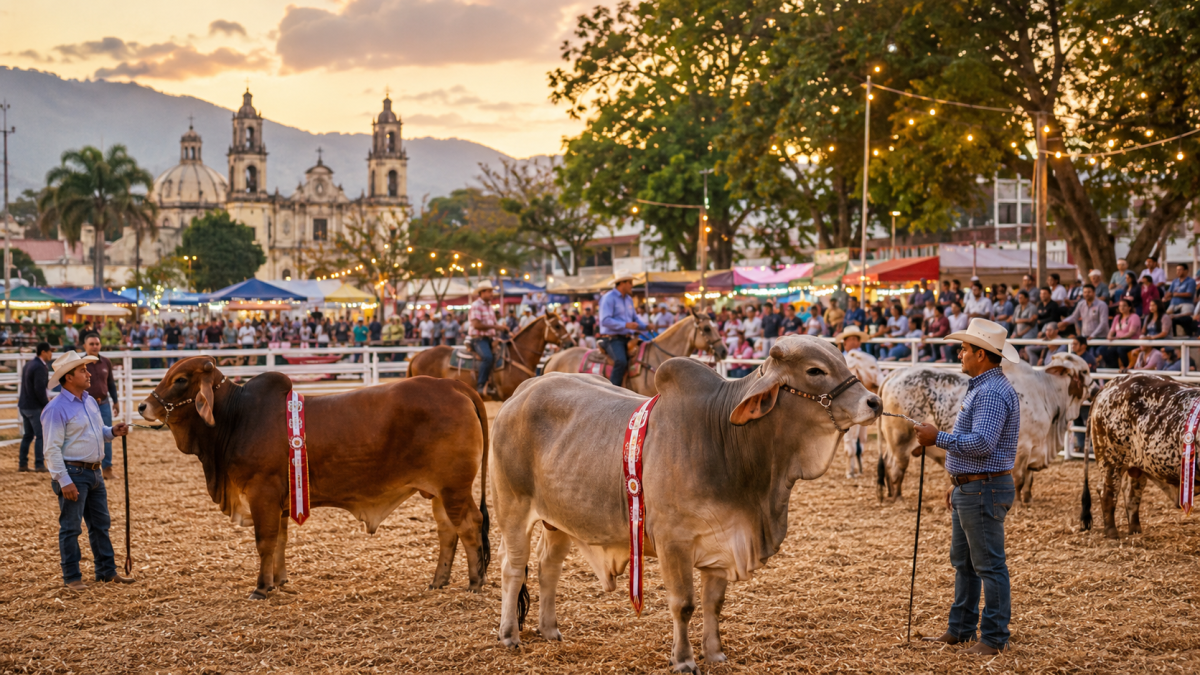
Many people outside El Salvador know the country mostly from news about security, politics, or Bitcoin. But in Santa Ana, there is a quieter, older story that has been growing for forty years in corrals, show rings, and family ranches. The Feria Ganadera Nuestra Señora Santa Ana, now marking its 40th anniversary, shows a different side of who we are and how we live.
From rail yards to regional landmark
Founded in 1986
The livestock fair was founded in 1986 and was originally held on the grounds of Ferrocarriles Internacionales de Centroamérica (IRCA), in the old Finca Modelo—today the Indes sports complex on the northwest side of Santa Ana.
What began as a local initiative to bring ranchers and buyers together has grown into the largest and most important livestock fair in El Salvador, a reference point not only for the western region but also for the national cattle industry.
Building its own home
As the years passed, the fair moved from borrowed rail land to its own facilities. This change reflects something bigger: livestock production became more professional, breeder associations grew stronger, and Santa Ana became a center for agro-industrial activity in western El Salvador.
A fair that shapes the herd: genetics and productivity
Center of cattle trade and breeding
Every year, the fair gathers over 350 cattle from various ranches and breeds, with a focus on animals with strong genetics. It is now the main place in El Salvador to buy and sell registered cattle, breeding stock, and stallions, which are key to improving herds across the country.
Filiberto Guerra, president of the Asociación Feria Ganadera Nuestra Señora Santa Ana and a second-generation rancher, describes the fair as “the largest center for the purchase of registered cattle and cattle for breeding and stallions in the country,” emphasizing its role in genetic improvement and the overall development of Salvadoran livestock.
Genetics as a quiet transformation
In El Salvador, rural livelihoods are often overlooked. The fair’s focus on genetics is not just a technical matter—it shows a long, steady effort to:
- Improve productivity: Better genetics mean more milk, more meat, and more resilient animals.
- Raise standards: Registered cattle and judged competitions push ranchers toward record‑keeping, health controls, and selective breeding.
- Connect El Salvador to the region: The fair brings together breeders and judges from across Central America, putting Salvadoran cattle into a broader discussion of quality and innovation.
This is a story of progress that rarely gets attention. Small and medium producers are investing in better animals, improved practices, and a stronger rural economy.
Fiestas Julias: where faith, family, and livestock meet
A patronal destination
The fair is one of the main attractions of the Fiestas Julias in Santa Ana Centro, the city’s patronal celebrations. Every year, around 100,000 visitors pass through the fairgrounds, making it a preferred destination for locals and visitors alike.
Here, the religious calendar, city celebrations, and the farming cycle come together. Livestock producers are part of city life, bringing their animals, families, and traditions into the center of the festivities.
Beyond corrals: a full cultural program
The fair is not only about cattle. Its program includes:
- Jaripeos and ribbon races: Rodeo‑style events and traditional horseback competitions.
- Judging and contests: Formal evaluations of cattle and popular competitions like the “vaca lechera” (dairy cow).
- Concerts and music: Daily concerts with orchestras and national groups, blending rural identity with contemporary entertainment.
- Gastronomy and family spaces: Food stalls, typical dishes, and areas designed for families to spend the day together.
In this blend of livestock, music, and food, you can see another side of El Salvador—one that values work, land, and community as part of its culture.
Forty years of continuity: families, identity, and pride
A generational legacy
The fair’s history is also a family story. Juan Guerra, one of the founders, handed leadership to his son, Filiberto, who now heads the association. This passing of knowledge from one generation to the next is common in Salvadoran rural life, where families share what they know about animals, land, and markets.
In 2026, Valeria Sofía Reyes Viera was crowned Reina de la Asociación Feria Ganadera, bringing together youth and tradition. She stands for a new generation joining a legacy built over forty years, showing pride in local roots and a willingness to embrace the future.
Identity beyond stereotypes
When we talk about El Salvador, we rarely talk about:
- The breeders who spend years improving a bloodline.
- The families who plan their year around the fair.
- The young people who see livestock not as a relic of the past, but as a modern, technical field with regional reach.
These stories are part of El Salvador’s identity. The Santa Ana Livestock Fair shows the country as a place of continuity and care, where people invest in animals, land, and community for many years.
A different side of El Salvador
While national stories often focus on economic numbers or security statistics, the 40th anniversary of the Feria Ganadera Nuestra Señora Santa Ana encourages us to look more closely at the everyday forces driving change.
Here, development is not a slogan; it is:
- A fairground built from scratch over forty years.
- A herd improved, animal by animal, through careful breeding.
- A city that welcomes 100,000 visitors to celebrate work, faith, and festivity together.
This livestock fair is more than just an event. It is a living record of how El Salvador’s rural and urban worlds come together and grow. Visiting the fair shows a country that is more than its headlines—a place of ranchers and families, music and jaripeos, genetics and tradition, all gathering under the lights of Santa Ana’s Fiestas Julias.
If you like stories about El Salvador’s growth, economy, tourism, culture, environment, and ongoing change, please like, comment, and share this article.
Leave a Reply