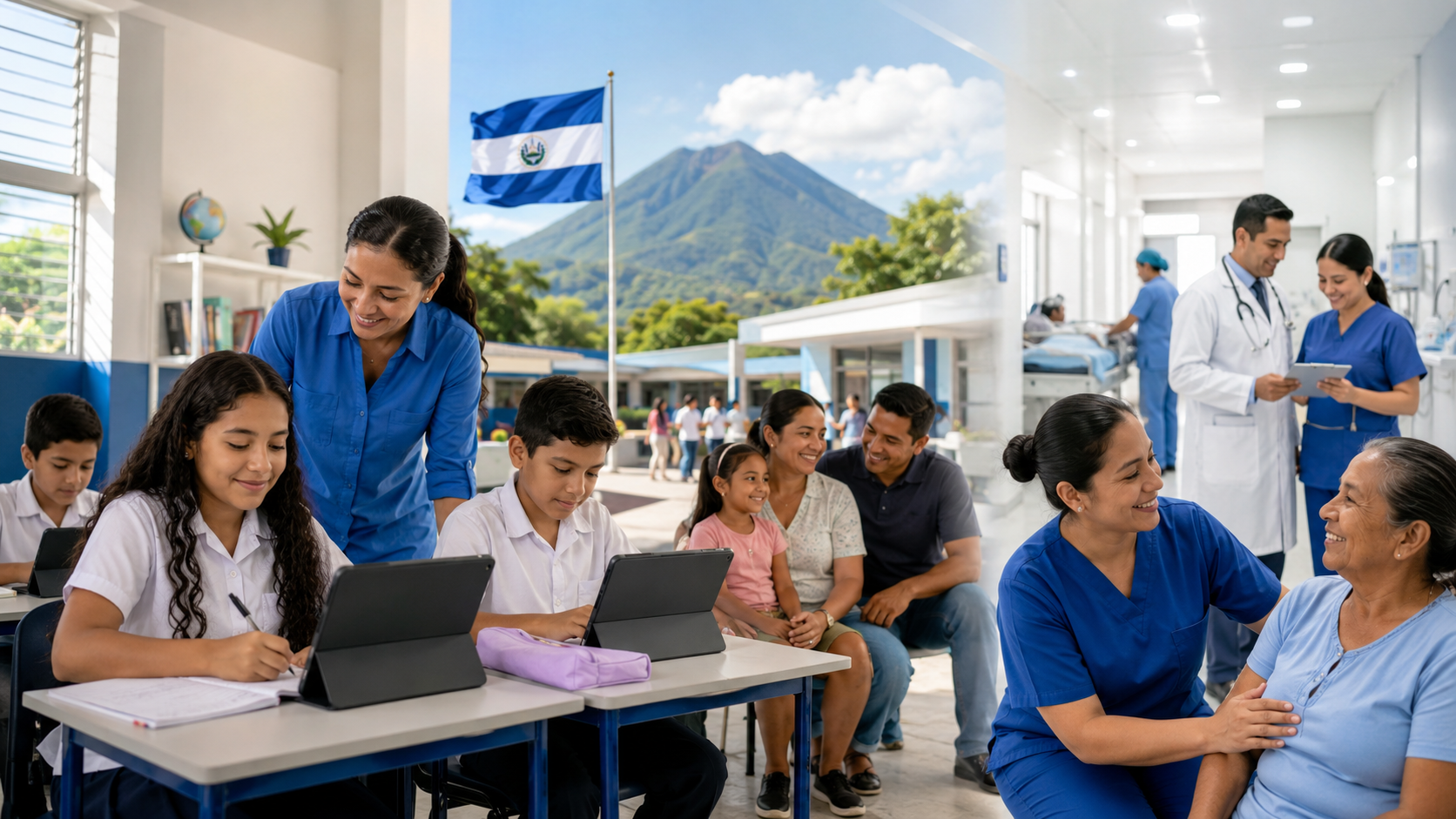
El Salvador education and health improvements are becoming part of the national conversation as many families report seeing changes in schools, clinics, and hospitals.
A new public opinion survey is giving a clear look at how many Salvadorans feel about two areas that touch daily life more than almost anything else: education and health.
According to the latest Iudop/UCA evaluation of President Nayib Bukele’s seventh year in office, 80.4% of respondents said public education has improved, while 59.5% said the quality of attention in the public health system is better. The survey was carried out from May 15 to May 26, 2026, through 1,271 in-person interviews across the country, with a 95% confidence level and a margin of error of ±2.75%.
These numbers matter because they reflect more than politics. They show how families are experiencing services in their own communities — the school their children attend, the clinic they visit, and the public institutions they depend on.
Education Stands Out
The strongest public response came in the education sector. In the survey, 80.4% of Salvadorans said the quality of public education has improved during this period, while 9.8% said it has worsened and 8.1% said it remains the same.
That is a significant response, especially in a country where public schools have faced years of challenges. For many families, education is not an abstract government program.For many families, education is deeply personal. It begins in the classroom where a child learns to read, but it also includes the school building itself, the materials students receive, the uniforms they wear, the technology they use, and the safer environment that helps them learn with confidence.
Across El Salvador, school renovations, student support programs, and new technology have become part of the national conversation. These efforts are visible, and when people can see change with their own eyes, it shapes how they judge progress.
For parents, small things can make a large difference. A backpack, a uniform, learning materials, or a better-equipped classroom can reduce pressure on the household. It can also give children a stronger sense of dignity when they walk through the school gate.
Health Care and Daily Experience
The health sector also received a favorable response, though not as high as education. According to the survey, 59.5% of respondents said the quality of attention in the public health system is better, while 24.2% said it is worse and 13.5% said it remains unchanged.
Health care is one of the most sensitive areas of public life. People judge it not only by buildings or announcements, but by what happens when they need help. Was the patient attended to? Was the wait reasonable? Were services organized? Did the family feel respected?
In that sense, perception becomes important. It does not replace a technical audit or a full review of hospital resources, medicine supply, staffing, or long-term outcomes. But it does show whether people feel a difference when they seek care.
Digital health initiatives are also becoming part of this conversation. The survey asked about DoctorSV, including its second phase focused on patients with chronic illnesses. On that question, 46.6% said the program responds “mucho” to the needs of people with chronic conditions, while 18.6% said “algo.”
For patients dealing with diabetes, hypertension, kidney problems, or other long-term conditions, better follow-up can mean less uncertainty. Families do not want health care only when there is an emergency. They need guidance, organization, and access before a situation becomes critical.
Perception Is Not the Whole Story — But It Matters
It is important to be fair about what a survey can and cannot tell us.
Public opinion is not the same as a medical report, school performance review, or budget analysis. It does not answer every question about cost, staffing, equipment, medicine availability, or long-term results.
But perception is still a social indicator. When people say education and health are moving in a better direction, they are speaking from lived experience. They are responding to what they see, hear, and feel in their communities.
That matters.
A government can publish plans and numbers, but families measure progress differently. Families recognize progress in practical ways: when their child receives better support at school, when a clinic visit feels more organized, when a hospital provides more attentive care, and when public services begin to feel closer, more modern, and more reliable.
A Country Watching Its Own Transformation
El Salvador continues to move through a period of big change. Some of that change is debated, and Some are celebrated. Some still need more explanation, more transparency, and more time to prove their lasting value.
But surveys like this help capture the national mood. They show where people believe progress is happening and where expectations remain high.
In education, the public response is especially strong. In health, the numbers also show a majority seeing positive movement, while reminding us that many people still believe more work is needed.
That balance is important. Progress should be recognized, but public services must always continue improving. Schools need constant investment. Hospitals need resources. Digital tools must be reliable and accessible. Families need to feel that the system works not only in announcements, but in daily life.
A Positive Sign for Salvadoran Families
For me, the most important part of this survey is not just the percentage. It is what those numbers represent.
They represent parents who feel their children have better opportunities, and patients who sense changes in public health care. They represent communities watching their country move in a new direction.
Education and health are two of the foundations of any nation. When people begin to feel progress in those areas, it strengthens confidence in the future.
El Salvador still has challenges. No serious person would deny that. But when a majority of Salvadorans say they are seeing gains in schools and health services, that is worth paying attention to.
It shows that the transformation of the country is not only being discussed in government offices or newspaper headlines.
It is being noticed by the people who live it every day.
A Personal Note on Health Care
I have to be honest: the 59.5% number on health care surprised me.
I do not know exactly who was surveyed, but I live here, and I have used the public health system myself. In 2016, I had heart surgery in a hospital in San Salvador. That operation saved my life. At that time, the hospital building and conditions were in very bad shape, but the doctors were outstanding. They worked with skill, dedication, and compassion, even when the system around them clearly needed improvement.
That is why the changes in health care under President Bukele stand out so strongly to me. Anyone who remembers how things looked before and sees what is happening now can recognize that the country has made major progress. Hospitals have been renovated, new facilities have opened, technology has improved, and public health has become a much greater national priority.
This does not mean every problem has disappeared. No health system is perfect, and there will always be patients who experience delays, shortages, or frustration. But from my own experience living here, the difference between then and now is dramatic.
For me, this is not just a statistic. It is personal. I saw the old system up close, and I am seeing the new investments with my own eyes. That is why I believe the progress in health care deserves more recognition than that number alone may suggest.
If you enjoy stories about El Salvador’s culture, development, tourism, and transformation, please consider liking, commenting, and sharing this article.
How science, mangroves, and local communities are helping protect one of the country’s endangered sea turtles
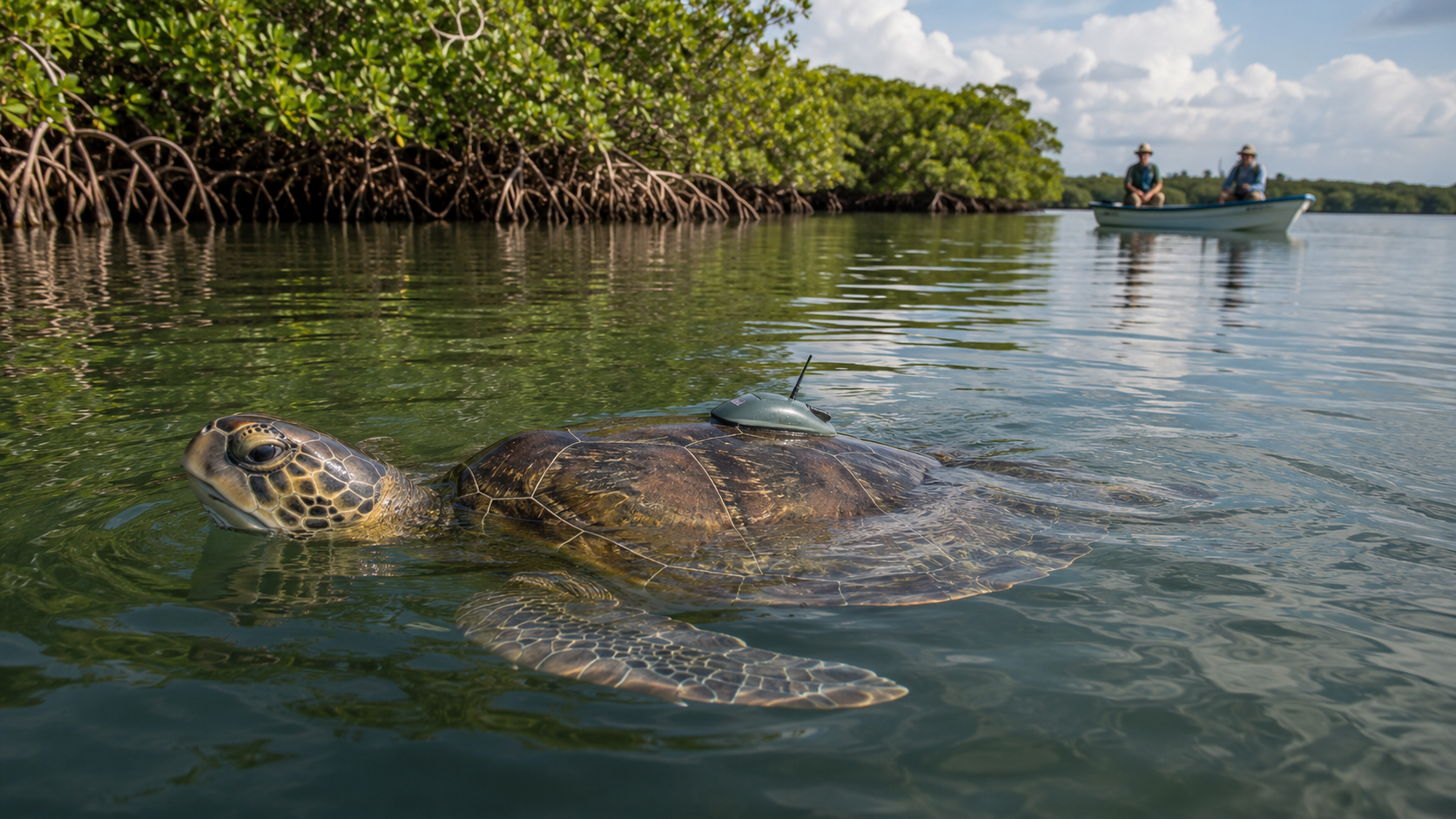
In Bahía de Jiquilisco, the movement of one endangered sea turtle is helping El Salvador see its coastline in a new way. Through a pioneering satellite tagging program, the tortuga prieta, or black turtle, is beginning to reveal a journey that has long taken place beyond human view. According to a recent report in Diario El Salvador, this effort allows scientists and conservation groups to follow the turtle’s movements in real time, opening a clearer window into how this species lives, feeds, and travels through Salvadoran waters.
For a country with a small coastline, this is a significant step. It shows that El Salvador’s beaches, mangroves, and wetlands are not only places of beauty and daily life. They are also living laboratories, where science, community, and conservation are beginning to work together in a deeper way.
A New Chapter for the Tortuga Prieta
The initiative is being carried out by Fundación Naturaleza El Salvador, FIAES, Red Xiuhtic, and the Ministry of Environment and Natural Resources, known as MARN.
Their focus is the tortuga prieta, a Pacific population of the green sea turtle. In El Salvador, this species is considered endangered, and much of its life remains difficult to study because it spends most of its time in the ocean.
Only females come ashore to nest, and even that happens during limited periods. For the rest of their lives, these turtles move through waters most people never see. They feed, rest, travel, and survive in places that have often remained invisible to science.
That is why satellite tagging matters.
Until now, much of the country’s satellite research on marine turtles had focused on the critically endangered hawksbill turtle, known in El Salvador as the tortuga carey. Expanding this technology to the tortuga prieta opens a new window into how another important species uses Salvadoran waters and the wider Pacific.
This is not just a technical project. It is a milestone for marine conservation in El Salvador.
Why Bahía de Jiquilisco Matters
Bahía de Jiquilisco is one of El Salvador’s most important coastal ecosystems. It is a Ramsar wetland recognized internationally for its ecological value and contains a rich mix of mangroves, channels, seagrass beds, reefs, beaches, and coastal communities.
For the tortuga prieta, this area offers more than a place to pass through. It provides food, shelter, resting zones, and nesting areas. The same mangroves that protect coastlines and support fish populations also help sustain endangered wildlife.
This is one reason the satellite project is so important. It reminds us that conservation cannot be limited to one beach, one nesting season, or one species. A sea turtle’s life connects many habitats. If one part of that chain is damaged, the whole system suffers.
Protecting the tortuga prieta also means protecting mangroves, seagrass beds, coastal waters, and the communities that depend on them.
How Satellite Tagging Works
The project uses small satellite transmitters attached to the turtle’s shell. These devices are placed carefully on the carapace using materials designed to hold in saltwater without harming the animal.
When the turtle surfaces or the equipment contacts water, the transmitter sends signals through a satellite tracking system. Over time, those signals create a map of the turtle’s movements.
Researchers can begin to understand where the turtles travel, where they feed, how they use the mangroves, and what areas may need stronger protection.
The technology used in the program includes SPOT satellite transmitters and the Argos tracking system. These tools allow conservation teams to receive valuable location data and study behavior that would otherwise remain hidden.
The most important part is that this work follows scientific and animal-welfare protocols. During the training process, participants learned how to prepare, attach, and monitor the devices in a way that protects the health and natural behavior of the turtles.
Science must never come at the expense of the animal it is trying to protect. This project recognizes that balance.
Training Local Hands for Long-Term Conservation
One of the most encouraging parts of this initiative is the local participation behind it.
The training in Bahía de Jiquilisco brought together biologists, veterinarians, field technicians, community leaders, and organizations connected to marine turtle conservation. Many of these people already work close to the beaches, mangroves, and coastal communities where turtles nest or feed.
That matters.
Conservation is strongest when local people are not treated as outsiders to the science, but as partners in it. The people who live near the mangroves, patrol the beaches, protect nesting sites, and understand the rhythm of the coast carry knowledge that cannot be replaced by technology alone.
Satellite transmitters provide data. Communities provide presence, memory, care, and daily commitment.
When both come together, conservation becomes more complete.
What the First Turtles Are Teaching Us
The first phase of the project has already tagged four tortugas prietas. The broader study plans to monitor up to eight individuals, giving researchers a better understanding of how this species uses the Salvadoran coast.
Early information has revealed a fascinating pattern. When the tide rises, the turtles enter the mangrove areas. When the water level drops, they return toward the open ocean.
That detail may sound simple, but it carries a powerful message. It shows that the tortuga prieta is not only tied to beaches or open water. It also depends on the mangrove forest.
This finding strengthens what conservationists have been saying for years: mangroves are not empty swamps or wasted land. They are nurseries, feeding grounds, natural barriers, and wildlife corridors. They protect life in ways that are not always visible from the road or the shoreline.
For the black turtle, the mangroves of Bahía de Jiquilisco may be part of a daily survival pattern.
From Turtle Signals to Better Decisions
Every signal sent by a tagged turtle becomes more than a point on a map. It becomes information that can guide decisions.
This data can help researchers and government institutions identify key feeding areas, resting zones, travel routes, and habitats that need protection. It can also support environmental education programs in nearby communities.
That is where science becomes practical.
A map can help shape a conservation plan. A movement pattern can help protect a feeding area. A better understanding of habitat use can guide local outreach, fishing practices, school programs, and regional cooperation.
El Salvador is part of the Eastern Pacific, a region where marine species do not stop at national borders. A turtle that feeds in Salvadoran waters may later travel far beyond them. This makes cooperation with neighboring countries and international conservation networks even more important.
The tortuga prieta belongs to the ocean, but El Salvador has a responsibility for the time it spends along our coast.
A Broader Way to See the Salvadoran Coast
This project also invites us to look at El Salvador differently.
When people think of national progress, they often think of highways, airports, tourism, security, exports, or investment. Those things matter. But progress is also found in the protection of ecosystems that future generations will inherit.
A country’s future is not only built in concrete. It is also shaped by wetlands, forests, rivers, reefs, and coastlines.
Bahía de Jiquilisco is not just a scenic place on a map. It is a living system where turtles, fish, birds, mangroves, fishermen, researchers, and local families are connected.
The same coast that supports livelihoods can also support science. The beach that welcomes visitors can also protect a nesting turtle. The same mangrove channel that looks quiet from a distance may be carrying the story of a species that has traveled the Pacific for generations.
Why This Story Matters
In a world where so many environmental stories feel discouraging, this one offers something different.
It offers hope with discipline behind it.
Hope, because El Salvador is taking steps to better understand and protect an endangered species. Discipline, because this work depends on data, training, cooperation, and long-term commitment.
The tortuga prieta cannot speak for itself in meetings or policy discussions. But through satellite tagging, its movements begin to tell a story. They show where it goes, what it uses, and what it needs.
That information gives the turtle a kind of voice.
It also gives the country a responsibility to listen.
Looking Ahead
The satellite tagging of the tortuga prieta is still in its early stages, but its direction is promising.
As more data is collected, El Salvador will have a clearer picture of how this species uses its coastal waters. That knowledge can strengthen national conservation programs, support local education, and help protect habitats that are easy to overlook.
This work also builds on the country’s experience with hawksbill turtle conservation, helping create a broader understanding of how different marine turtles depend on Salvadoran ecosystems.
That is important because no species exists alone. The health of the tortuga prieta is connected to the health of the mangroves, the water, the seagrass, the beaches, and the people living nearby.
Final Reflection
The story unfolding in Bahía de Jiquilisco may seem quiet compared with the headlines that usually dominate the day. But it is not small.
Each tagged turtle is a traveler, a teacher, and a reminder that El Salvador’s natural heritage extends far beyond what we see from land.
For most of its life, the tortuga prieta moves beyond human view. Now, with the help of science and community effort, we are beginning to follow its path and understand its needs.
That matters.
Because conservation begins with knowledge. It grows through cooperation. And it becomes real when a country decides that even the quietest lives along its coast are worth protecting.
En nuestras costas, la ciencia y la comunidad se están encontrando.
And in that meeting, the tortuga prieta finally has a voice.
If you enjoy stories about El Salvador’s culture, development, tourism, history, and transformation, please consider liking, commenting, and sharing this article.
Harmony of the Cosmos
My book Harmony of the Cosmos shares the deeper story of my life — from childhood through adulthood, with the memories, lessons, losses, spiritual reflections, and quiet guidance that shaped the person I became.
It is a personal memoir about life’s unexpected turns and the unseen ways our path often comes together over time.
The book is available on Amazon in English and Spanish.
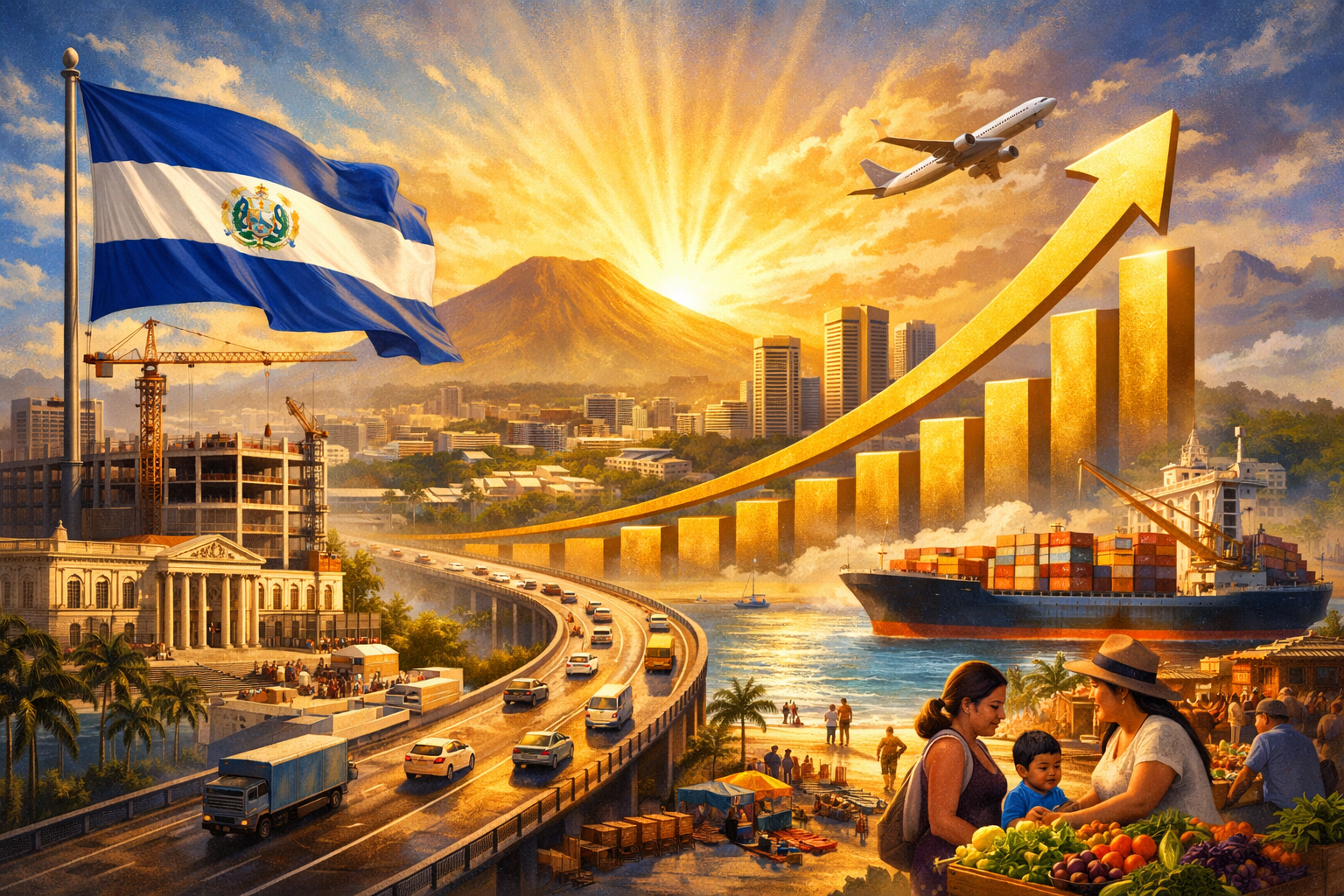
El Salvador began 2026 with a figure that deserves attention: the economy grew by 4.8% in the first quarter of the year.
For a country that spent many years moving at a slower pace, this figure stands out. It is not just another economic statistic. It suggests that something broader is happening across the country — in construction, tourism, trade, public investment, household income, and the everyday confidence people feel when they decide to build, spend, visit, invest, or open a small business.
For those of us living here, this growth does not feel distant. You can see it in the roads, markets, airports, coastal towns, construction sites, and the steady movement of people and goods.
Numbers matter, but in El Salvador, economic change is often felt before it is fully understood.
A Quarter That Broke the Pattern
According to the Banco Central de Reserva, El Salvador’s economy grew 4.8% in the first quarter of 2026.
That is a strong result by recent historical standards, especially since the growth was not limited to a single area. Seventeen of nineteen productive activities expanded, representing more than 80% of the economy.
That detail is important.
When only one sector grows, the result can be fragile. A tourism boom, a construction wave, or a temporary rise in exports can lift the numbers for a while, but the foundation may remain narrow. This quarter looked different. The expansion was spread across several areas, suggesting a more balanced form of momentum.
That does not mean every family feels the benefit equally. It does mean the economy is moving through more than one channel at the same time.
Construction Leads the Way
The standout sector was construction, which grew by 13.5%.
This is not hard to believe when you drive through different parts of the country. New housing projects are rising. Roads are being repaired or expanded. Commercial spaces are taking shape. Logistics centers, public works, and infrastructure projects are changing the physical landscape.
Construction matters because it does more than produce buildings. It creates jobs, moves materials, supports transportation, generates demand for hardware stores, and gives people visible proof that investment is happening.
New roads can shorten a commute.
A repaired school can improve daily life for students.
Housing projects can create work for masons, electricians, drivers, suppliers, and small food vendors in the area.
An airport or logistics investment can affect trade far beyond the project itself.
This is why construction often becomes one of the clearest signs of economic confidence. People do not build when they expect things to stand still. They build when they believe tomorrow may be stronger than yesterday.
Private and Public Investment Are Moving Together
The BCR attributed the construction surge to both private and public investment.
Private investment has been visible in housing, commercial development, and logistics projects. Public investment has focused on roads, schools, airports, and other infrastructure meant to support long-term growth.
That combination matters.
Private investment shows confidence from businesses, developers, and families. Public investment lays the foundation for more activity later. When the two move together, the effects can spread through the wider economy.
A country cannot grow only through announcements. It needs roads that work, schools that function, airports that move passengers efficiently, ports that support exporters, and communities where businesses can operate with less uncertainty.
El Salvador still faces challenges, but this quarter shows that investment is becoming one of the main drivers of the country’s economic growth.
Logistics and Trade Gain Strength
Another important part of the story is logistics.
El Salvador’s location gives it natural advantages, but geography alone is not enough. Goods need ports, customs systems, roads, airports, warehouses, and reliable transport. When those systems improve, exporters and importers feel the difference.
Recent investments at the San Óscar Arnulfo Romero International Airport and the Port of Acajutla are part of that bigger picture. They support the movement of goods, reduce bottlenecks, and help El Salvador position itself as a more serious logistics hub in the region.
Exports also grew, supported by industrial products, traditional goods, and services.
For a small country, export growth is important because it connects local production to foreign markets. It means Salvadoran products are competing abroad. It also supports jobs in manufacturing, agriculture, transportation, packaging, and services tied to trade.
When exports rise, the benefits are not limited to large companies. Small suppliers, drivers, warehouse workers, farmers, and service providers can all become part of the chain.
Tourism Continues to Reshape the Country
Tourism remains one of the most visible parts of El Salvador’s transformation.
In the first quarter of 2026, the country received around 1.3 million international visitors. Security improvements, international promotion, major events, and the growing popularity of destinations such as Surf City, Ruta de Las Flores, Suchitoto, Apaneca, and El Tunco have helped reshape the country’s image.
This is one of the areas where the change feels especially personal.
Years ago, many people abroad associated El Salvador mainly with violence, migration, and instability. Today, more visitors are coming to surf, explore volcanoes, visit colonial towns, enjoy coffee country, attend concerts, and experience a country they may have once avoided.
That shift affects real communities.
Restaurants fill tables.
Hotels hire staff.
Guides find work.
Artisans sell more.
Transportation services expand.
Small towns begin to see visitors not as a rare event, but as part of their future.
Tourism is no longer only seasonal. In some areas, it is becoming structural — part of how communities think about income, opportunity, and local identity.
Household Income Helped Drive Consumption
Economic growth also depends on families having money to spend.
During the first quarter, household income received support from two important sources: labor-related changes and remittances.
The Ley de la Quincena 25 gave many workers additional disposable income. Remittances also remained a powerful force, reaching approximately $2,435.6 million during the first three months of 2026.
That money matters.
Remittances are not just financial transfers. They are family lifelines. They help pay for food, medicine, education, home improvements, transportation, and emergencies. Many communities also support small businesses, construction projects, and local commerce.
When families have more income, they spend more in the local economy. That supports tiendas, markets, restaurants, hardware stores, transportation providers, and service businesses.
This is the quiet side of economic growth. It does not always appear in photos of airports or construction cranes, but it can be felt in a family’s ability to buy what they need, repair a home, or plan with a little more confidence.
Commerce, Restaurants, and Services Feel the Effect
When household income rises, the service economy often feels the impact quickly.
People buy groceries, eat out, travel, repair vehicles, purchase clothing, visit shopping centers, and spend on entertainment. Some of that spending is modest, but across millions of transactions, it becomes important.
This is why private consumption remains a major part of El Salvador’s economic story.
A family that has a little extra money at the end of the month may not think of itself as part of GDP growth. But every purchase contributes to economic activity.
A meal in a restaurant.
A bag of cement.
A school uniform.
A bus trip.
A hotel stay.
A repaired motorcycle.
A new refrigerator.
These choices may look small individually, but together they help explain why commerce and services continue to matter so much.
Public Services Create a Stronger Foundation
The BCR also pointed to improvements in public services, especially in health and education.
These areas may not always receive the same attention as construction or tourism, but they are essential to long-term economic resilience.
In health care, the expansion of the national hospital network and the adoption of digital tools such as DoctorSV are part of a broader effort to improve access and coverage. A stronger health system helps families, workers, employers, and communities. When people can receive care earlier and closer to home, the benefits extend beyond the hospital walls.
Education also plays a major role. School supply packages, technology programs, and improvements in learning conditions reduce barriers for students and families. A child with access to school materials and digital tools has a better chance of participating in the modern economy.
Economic development is not only about what gets built today. It is also about preparing people for tomorrow.
A Broader Growth Story
The most encouraging part of the first-quarter report is the breadth of the growth.
Investment, consumption, foreign trade, tourism, construction, logistics, public services, and remittances all played a role. That makes the 4.8% figure more meaningful than a temporary spike driven by one source.
A multisectoral economy is stronger than one dependent on a single engine.
Tourism can rise or fall.
Exports can face global pressure.
Construction can slow.
Remittances can change with conditions in the United States.
But when several areas are moving together, the country has more ways to absorb pressure and continue forward.
That is why this quarter feels important. It suggests that El Salvador may be moving into a different economic rhythm.
What This Looks Like From Daily Life
Living here, you don’t just see economic growth in official reports.
In daily life, the signs appear in many ways: busier roads, new businesses opening their doors, small towns welcoming more visitors, construction materials moving through rural areas, and conversations about remodeling, investing, or starting something new.
In places like Cara Sucia, Sonsonate, Ahuachapán, La Libertad, and San Salvador, the signs are different but connected. Some are large, like airport improvements and new developments. Others are small, like a family adding a room, a restaurant hiring help, or a tienda keeping more inventory on the shelves.
Economic confidence does not always arrive loudly. Sometimes it appears in practical decisions made day after day.
Reasons for Optimism and Reasons for Care
This quarter gives El Salvador reasons to be optimistic.
A 4.8% growth rate is strong. Construction is moving. Tourism continues to expand. Remittances are supporting families. Trade and logistics are gaining strength. Public investment is helping modernize key parts of the country.
But growth also brings responsibility.
The country must make sure development reaches more than the most visible areas. Rural communities, small farmers, informal workers, and families outside the main tourism corridors need to feel included in the progress.
Infrastructure should be planned carefully.
Tourism should grow without damaging the natural beauty that attracts visitors.
Public spending should remain transparent.
Economic confidence should be supported by strong institutions, good planning, and long-term thinking.
Growth is good news, but sustainable growth is the real goal.
A Country in Motion
El Salvador’s first quarter of 2026 showed more than economic expansion. It showed momentum.
The 4.8% growth figure matters because it reflects activity across many parts of the country. It points to a nation building, moving, receiving visitors, exporting products, supporting families, and investing in its future.
For those of us who live here, the story is not only in the data. It is in the visible changes around us.
Roads are improving.
Tourism is reshaping communities.
Construction is changing landscapes.
Families are spending and investing.
Businesses are looking to the future with greater confidence.
There are still challenges, and no serious discussion of the economy should ignore them. But this quarter shows that El Salvador is not standing still.
The country is moving.
And when confidence begins to take root across different parts of society, it can become one of the most powerful forces a nation has.
Final Thoughts
El Salvador’s 4.8% economic growth in early 2026 is more than a quarterly statistic. It is a sign of direction.
It reflects construction cranes, tourism flows, remittance support, trade activity, public investment, and the everyday decisions of families and businesses.
The real question now is how the country builds on this momentum.
Growth should not only be measured by numbers on a chart. It should also be measured by opportunity, stability, better services, stronger communities, and the ability of ordinary families to feel that progress is reaching them.
This first quarter gave El Salvador a strong start to the year.
Now the challenge is to turn momentum into lasting development.
If you enjoy stories about El Salvador’s culture, development, tourism, and transformation, please consider liking, commenting, and sharing this article.
If you enjoy stories about El Salvador’s culture, development, tourism, and transformation, please consider liking, commenting, and sharing this article.
Two reports landed in the same news cycle this week, and together they tell a much larger story about El Salvador.
One report focuses on the government’s bitcoin reserve — a national holding that continues to grow inside a public wallet. The other looks at remittances sent through cryptocurrency wallets, where families abroad use digital tools to send money home.
At first glance, these may seem like two separate stories. One belongs to the world of national policy, international finance, and sovereign strategy. The other belongs to ordinary families, monthly expenses, and the practical need to move money across borders.
But here in El Salvador, both stories matter.
They share the same country. They share the same technology. And they both raise a question that has followed El Salvador since bitcoin first became part of the national conversation:
What is Bitcoin really for?
The Numbers Behind the Story
According to recent figures from El Salvador’s Banco Central de Reserva and the Oficina Nacional del Bitcoin, two trends are moving at the same time.
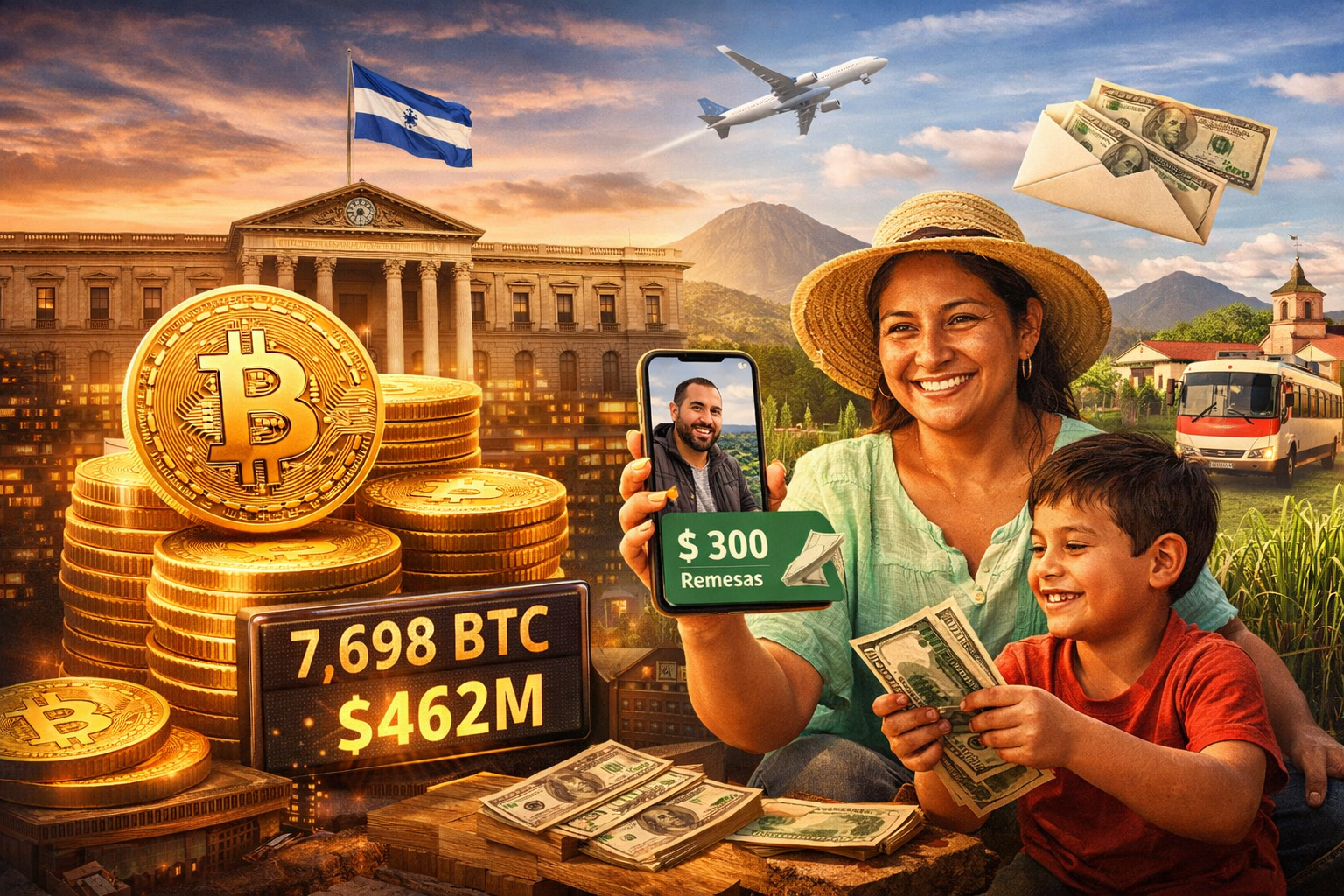
From January through May 2026, remittances received through cryptocurrency wallets reached $29.25 million. That represents a 41.8 percent increase compared with the same period in 2025, when the figure was $20.63 million. The number of transactions also increased to 94,530, while the average amount sent rose from $266.50 to $309.43.
Those numbers suggest that crypto remittances are becoming more active again, even after the country stepped away from the more public part of its bitcoin experiment.
At the same time, El Salvador’s sovereign bitcoin reserve has reportedly reached 7,698 coins. At a bitcoin price of roughly $60,000, that reserve would be valued at approximately $462 million.
These two numbers tell very different stories.
One is about a national reserve. The other is about families sending money home.
One is shaped by government policy. The other is shaped by daily necessity.
The National Reserve: A Long-Term Bet
El Salvador’s bitcoin reserve is a top-down project. It is deliberate, institutional, and tied to the government’s belief that bitcoin may become more valuable over time.
President Nayib Bukele’s administration began purchasing bitcoin several years ago and has continued to defend the strategy through both criticism and market volatility. The idea is similar to what investors call dollar-cost averaging: buying steadily over time rather than trying to predict the perfect moment.
Supporters see this as bold and visionary. They argue that El Salvador positioned itself early in financial technology, which could grow in importance over the coming years. They also see the reserve as part of a larger effort to place the country on the global map for innovation, investment, and independence.
Critics see something very different. They worry about volatility, transparency, and the risk of placing public resources into an asset that can rise or fall sharply. For a small country with many urgent needs, those concerns should not be dismissed.
That is the reality of the Bitcoin reserve. It is not an everyday tool for most Salvadorans. It is a national bet made on behalf of the country.
Whether it becomes a wise decision or a costly one will depend on forces far beyond El Salvador’s control.
The Remittance Story Is Different
The remittance story feels much closer to daily life.
When someone in Los Angeles, Houston, Washington, New York, or Virginia sends money home through a cryptocurrency wallet, that person is usually not trying to make a political statement. They are not thinking about sovereign reserves or international headlines.
They are looking for a transfer that costs less, arrives faster, and gives them confidence that the money will reach the people waiting for it back home — parents, spouses, children, grandparents, or relatives who depend on that support.
That is a very different kind of decision.
For many Salvadoran families, remittances are not extra money. They are part of the household economy. They help pay for food, medicine, school supplies, building materials, transportation, and small improvements to family homes.
A few dollars saved on each transfer may not sound like much to someone reading a financial report. But when money is being sent month after month, those savings can matter.
For a family operating on a tight budget, lower transfer costs are not a theory. They are real.
A Practical Use for a Complicated Technology
Bitcoin and cryptocurrency can sound complicated, especially for people who do not use digital wallets or follow financial markets. For many Salvadorans, the early bitcoin rollout felt confusing, rushed, or disconnected from their daily reality.
That may be one reason the original Chivo wallet experiment struggled to become part of ordinary commerce. Many people received the sign-up bonus, but that did not mean bitcoin became a normal part of their lives.
Buying pupusas, paying for groceries, or taking a bus does not require a national technology experiment. People use what is simple, familiar, and trusted.
But remittances are different.
A money transfer already involves distance, fees, waiting, identification, and trust in a service provider. If a digital wallet can reduce costs and get money to arrive faster, some families will try it — not because they are loyal to bitcoin, but because it solves a practical problem.
That may be the most important lesson here.
Technology does not become useful because a government announces it. It becomes useful when ordinary people find a reason to keep using it.
The Chivo Chapter Has Changed
El Salvador’s bitcoin story has already changed since 2021.
The country made global headlines when bitcoin became legal tender. Businesses were expected to accept it; the Chivo wallet was introduced, and El Salvador became a symbol in the worldwide debate over cryptocurrency.
For some, that moment was exciting. For others, it was unsettling.
Over time, public use remained limited. Many Salvadorans continued to prefer the U.S. dollar for daily transactions. Surveys repeatedly showed that most people were not using bitcoin in everyday commerce.
Then came the agreement with the International Monetary Fund. As part of that process, bitcoin acceptance became voluntary, its status as legal tender was removed, and the government began moving away from direct participation in the Chivo wallet system.
That means the public-facing experiment has been reduced.
But it has not disappeared completely.
The state continues to hold bitcoin. Families continue to use digital channels for some remittances. The experiment is no longer the same one announced in 2021, but it is still alive in a different form.
Ahuachapán and the Local Picture
One detail in the remittance data stands out for those of us living in western El Salvador.
Ahuachapán recorded the highest interannual remittance growth among departments during the January-to-May period, up 8.5 percent from last year.
That deserves attention, but also caution.
A high percentage increase does not automatically mean a department is becoming wealthy. Growth from a smaller base can produce strong percentages. Ahuachapán still faces many economic challenges, especially in rural areas where opportunity can be limited.
But the direction is meaningful.
Families connected to this region are sending more money home. That tells us something about the strength of the Salvadoran diaspora and the continuing importance of family ties across borders.
Living here, you notice this before you read it in a report.
You can see it in small but meaningful ways: a new roof on a family home, a tienda with full shelves, an extra room added little by little, a child staying in school, medicine purchased on time, a porch finally finished, or a small business making it through another month.
Not all of that comes from remittances, of course. People here work hard, save carefully, and build slowly. But remittance money is part of the quiet foundation underneath many communities.
It may not attract the same headlines as a bitcoin reserve, but it touches daily life in a much more direct way.
The Diaspora Remains an Economic Lifeline
El Salvador’s economy is deeply connected to its people abroad.
Millions of Salvadorans and Salvadoran descendants live outside the country, especially in the United States. They work in restaurants, construction, cleaning, transportation, factories, offices, landscaping, caregiving, and countless other jobs.
Every month, part of that income comes back home.
Those dollars are not abstract. They are a sacrifice.
They represent long hours, distance from family, and the responsibility many migrants continue to carry even after building lives elsewhere.
This is why remittances should always be discussed with respect. Behind every transfer is a human story — money earned through long hours, sent with care, and received by someone here who was counting on it.
Whether the transfer arrives through a bank, Western Union, a digital provider, or a cryptocurrency wallet, the purpose is usually the same: to support family.
That is the human side of the remittance economy.
Two Uses for the Same Technology
What we are seeing now is not one bitcoin story, but two.
The government sees bitcoin as a strategic asset — something to hold, accumulate, and possibly benefit from in the future.
Families using crypto remittances see it differently. For them, it is not about ideology or national branding. It is a tool. If it is cheaper, faster, and more reliable, it has value.
Those two uses do not always align.
A government reserve is about long-term positioning. A family transfer is about immediate need.
A national wallet can be debated in financial terms. A remittance is judged by whether the money arrived and how much was lost in fees along the way.
This is why the remittance side may prove more durable than the original retail Bitcoin experiment. People may not want to use bitcoin to buy everyday goods, but they may still be willing to use digital channels when sending money across borders.
That distinction matters.
The Question of Trust
For any financial system, trust is everything.
People need to trust that their money will arrive. They need to trust the platform, the exchange rate, the fees, and the ability to convert funds into a usable form.
This is one reason digital adoption can be uneven. Younger people or those with family abroad may be more comfortable with wallets and apps. Older people may prefer cash, banks, or familiar transfer offices.
In rural El Salvador, trust often grows slowly. People may try something once, then decide based on the result. If it works, they may use it again. If it fails, they may never return to it.
That is another lesson from the Bitcoin experiment.
Adoption cannot be forced by publicity. It has to be earned through usefulness, reliability, and confidence.
A Balanced View Is Needed
There is no need to turn this discussion into a simple argument for or against Bitcoin.
The truth is more complicated.
The national reserve could become a valuable asset if Bitcoin rises over time. It could also lose value if the market turns sharply. That risk belongs to the country.
Crypto remittances may help some families save money on transfers. But they also require access, knowledge, trust, and systems that ordinary people can use without confusion.
Both realities can exist at the same time. It is possible to recognize bitcoin’s potential while still taking its risks seriously, appreciate lower remittance costs while asking for public accountability, and respect innovation while remembering that technology should serve people — not the other way around.
What This Means for Daily Life Here
For most people in El Salvador, the bitcoin reserve is distant. It exists in reports, government statements, and international headlines.
Remittances are different.
They are felt at the kitchen table. They show up in school uniforms, at doctor visits, in bags of cement, with groceries, and during family emergencies.
That is why the remittance numbers matter so much.
They reveal how deeply connected this country remains to its people abroad. They also show that Salvadorans will use new financial tools when they help solve real problems.
In the end, this may be where the most lasting part of the bitcoin experiment is found — not in the headlines, but in the quiet transfer of money from one family member to another.
Where Things Stand Today
As of June 30, 2026, the picture looks something like this:
El Salvador’s bitcoin reserve has reportedly reached 7,698 BTC, with an estimated value of about $462 million at current market prices.
Crypto remittances through May totaled $29.25 million, up 41.8 percent from the same period last year.
The number of crypto remittance transactions rose to 94,530.
Total remittances through May reached $4.2 billion, one of the highest five-month figures in recent records.
Ahuachapán recorded the strongest departmental remittance growth in the country, at 8.5 percent.
Bitcoin is no longer legal tender in the same way it was under the original law, and the Chivo wallet system is being wound down.
Yet the story continues.
The reserve remains.
Families keep sending.
And here in western El Salvador, where life moves among sugarcane fields, small towns, family homes, and the steady rhythm of daily survival, both sides of the experiment are unfolding simultaneously.
One belongs to the state.
The other belongs to the family.
And in the long run, it may be the family side that tells us the most about what this technology is really worth.
Final Thoughts
El Salvador’s bitcoin experiment has changed shape since 2021. It is no longer simply about legal tender, public wallets, or whether people will buy coffee with bitcoin.
It has become something more divided, and maybe more revealing.
At the top, Bitcoin remains a national bet.
At the household level, digital remittances remain a practical choice.
The first story will be judged by markets, transparency, and time.
The second will be judged by families — by whether money arrives faster, costs less to send, and helps someone live a little better.
That may not be as dramatic as a headline about a national bitcoin vault.
But for many Salvadoran families, it may matter more.
Sources: Banco Central de Reserva de El Salvador, Oficina Nacional del Bitcoin, International Monetary Fund, World Bank Open Data, Diario El Salvador, EFE, and other referenced financial data sources.
If you enjoy stories about El Salvador’s culture, development, tourism, and transformation, please consider liking, commenting, and sharing this article.
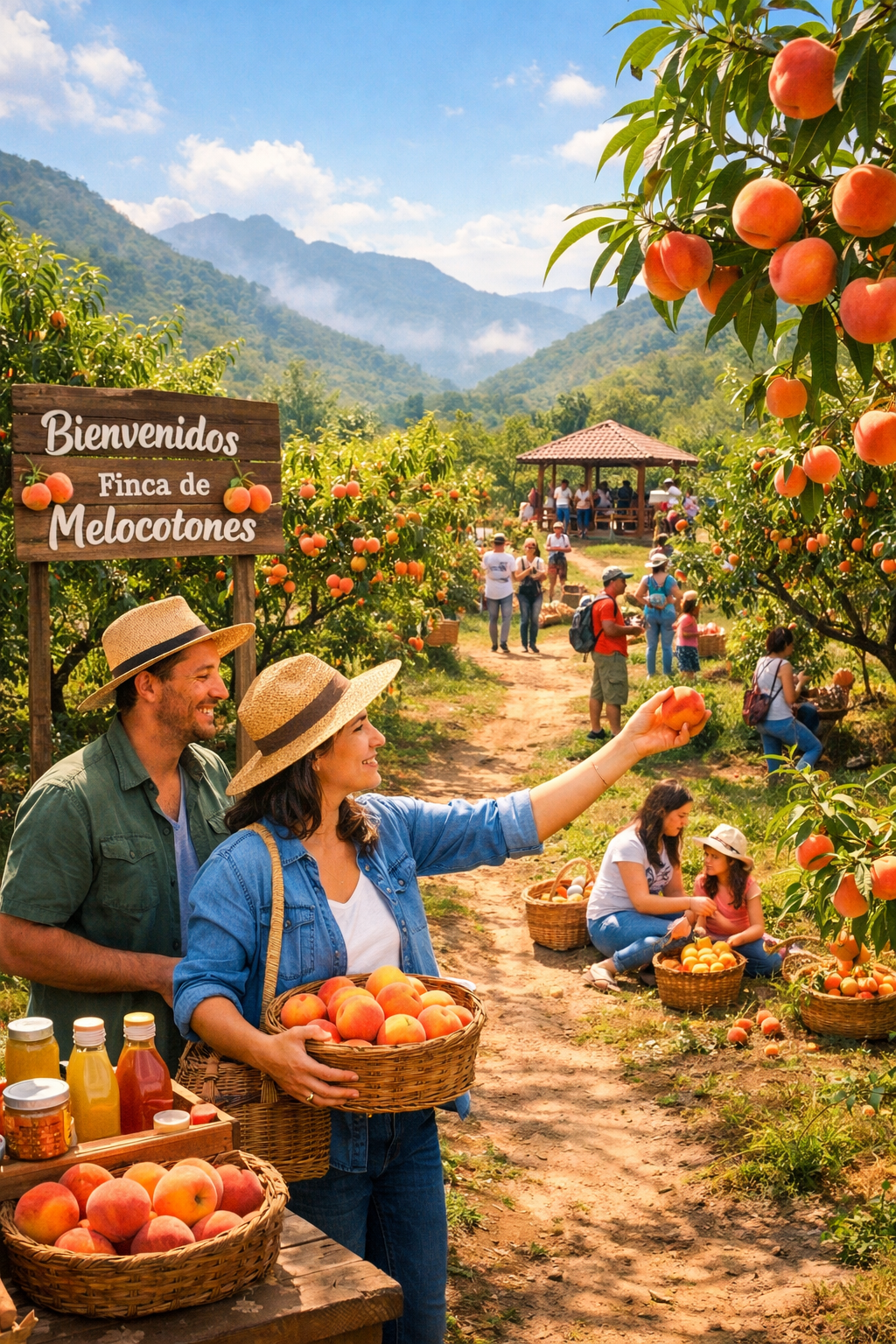
I grew up under peach and apple trees in Virginia, where the seasons were measured by blossoms, pruning, thinning, and harvest. There is something about fruit trees that stays with you. The smell of warm fruit in summer air, the feel of soft skin under your thumb, the quiet satisfaction of seeing branches heavy with the work of a year.
That is why reading about Elva Yasmín Méndez and her peach farm in Río Chiquito, San Ignacio, touched something familiar in me.
At first glance, Virginia and Chalatenango may seem worlds apart. One belongs to my childhood in the United States. The other rises into the cool mountains of northern El Salvador. But when I think about families working the land, opening their gates to visitors, and turning a harvest into something shared, the distance between them feels much smaller.
A Cool Mountain Corner of El Salvador
Río Chiquito sits in the highlands of Chalatenango Norte, one of the coolest and most scenic areas in the country. It is a place of mountain roads, misty mornings, vegetable fields, fruit trees, and views that remind visitors how diverse El Salvador really is.
Many people know this region because of El Pital, the highest point in the country. But Río Chiquito has its own quiet identity. It is not only a place to pass through on the way to somewhere else. It has become part of a growing rural tourism route where agriculture, food, family businesses, and mountain landscapes come together.
In this setting, the organic farm Nubes del Pital has become one of the local points of interest. There, Elva Yasmín Méndez cultivates melocotón diamante, or diamond peach, and welcomes visitors who want to experience the harvest up close.
What began as fruit trees on a hillside is now part of a broader story about rural development, community pride, and tourism rooted in the land.
Elva Méndez: Farmer, Host, and Example
Elva is not only a producer. She is also a host.
Her farm opens its gates to people who want more than a quick purchase at a roadside stand. Visitors can walk among the trees, learn about the crop, enjoy the cool mountain air, and see how a working finca becomes part of the tourism experience.
That matters because rural tourism works best when it feels real. People are not visiting a staged attraction. They are stepping into a place where families live, plant, harvest, cook, sell, and welcome others.
For more than a decade, Elva and other producers in the area have helped build interest in peach cultivation during harvest season. Through farm visits and participation in the Festival del Melocotón, they have shown how a small crop can become a source of income, identity, and connection.
The model is simple, but powerful:
Visitors come to the mountains.
Farmers open their orchards.
Families taste the fruit where it grows.
Local entrepreneurs sell jams, preserves, juices, desserts, and other products.
Money stays closer to the community.
That is the kind of tourism that feels personal. It is not only about taking a picture or buying a bag of fruit. It is about understanding the hands and landscape behind what you are eating.
The Festival del Melocotón
The Festival del Melocotón has become one of the most recognized agrotourism events in northern Chalatenango. Held in Río Chiquito, San Ignacio, the festival celebrates the peach harvest while also promoting local food, small businesses, and mountain tourism.
During the event, families can visit fincas, walk among the trees, taste fresh fruit, and buy directly from the producers. Local vendors also offer peach-based products such as mermeladas, melocotón en almíbar, conservas, natural drinks, desserts, and even wine.
For visitors, it is a day in the mountains.
For producers, it is much more.
It is a chance to sell directly, explain their work, build relationships, and show the value of agriculture beyond the farm gate. A peach is no longer just a crop. It becomes part of the region’s identity.
That is how places grow in the public imagination. Not only through roads and signs, but through flavors, traditions, and memories people carry home.
A Crop With Deeper Roots
The growth of peach cultivation in this part of Chalatenango did not happen by accident. It is connected to efforts by Plan Trifinio, working with agricultural and environmental programs, to introduce fruit species suited to the highland ecosystem.
The idea was practical: identify crops that could adapt to the climate, help protect the landscape, and create new sources of income for local families.
Peach trees found a place in that vision.
Because El Salvador does not have a large nursery system for these plants, some trees have been brought from Guatemala, a country with more experience in supplying peach plants for the region. Once planted in the cooler elevations of Chalatenango, the trees became part of a productive landscape that now supports both farming and tourism.
This is where public planning and daily work meet. A program may introduce the crop, but it is the farmer who tends the tree. It is the family that cares for the land. It is the community that turns a harvest into a festival.
Security, Tourism, and Confidence
Another important part of this story is security.
Producers in Río Chiquito have described their area as traditionally peaceful, but they also recognize that recent years have brought more visitors from inside and outside El Salvador. Better security across the country has helped many rural communities feel more confident about promoting themselves as destinations.
That confidence matters.
A family from San Salvador may be more willing to take a weekend trip.
A Salvadoran living abroad may be more curious to explore the country beyond the beach.
Foreign visitors may discover that El Salvador is not only surf, volcanoes, and city centers, but also cold mountain villages, small farms, fresh produce, and family-run tourism.
In Río Chiquito, the result is visible in a simple scene: visitors walking through orchards, children picking fruit, producers sharing their stories, and local vendors selling what they make with their own hands.
From My Virginia Farm to Elva’s Peach Rows
When I read about Elva’s farm, I can almost feel a ripe peach in my hand again.
On our farm in Virginia, fruit trees were part of life’s calendar. Blossoms came first. Then the small green fruit. Then the waiting. Then the work of harvest, when everything seemed to ripen at once, and the air carried that unmistakable sweetness.
Those memories never left me.
So when I imagine the rows of peach trees in Río Chiquito, I do not see only a tourism story. I see something more human. I see families making use of the land they have. I see a community finding value in what grows naturally in its climate. I see visitors discovering that agriculture is not something distant or old-fashioned, but something alive, beautiful, and necessary.
The orchard becomes a classroom.
It becomes a marketplace.
It becomes a place where children learn that food does not begin in a supermarket.
It becomes a meeting point between the countryside and the traveler.
Why This Matters for El Salvador
Stories like this may seem small compared with major infrastructure projects, new investments, or national economic announcements. But rural tourism is part of the same larger transformation.
When a community like Río Chiquito attracts visitors, several things happen at once. Farmers gain another way to earn income. Local cooks and artisans find customers. Young people see possibilities close to home. Visitors leave with a deeper understanding of the country.
This kind of development does not erase rural life. It strengthens it.
It does not ask farmers to abandon the land. It invites others to value it.
That is important for El Salvador, especially in areas where families have worked hard for generations but have not always had access to wider markets. A festival, a finca tour, or a jar of peach jam may seem simple, but each one carries effort, planning, and pride.
A Sweet Symbol of Chalatenango Norte
Over time, the peach has become more than a fruit in Río Chiquito. It has become a symbol of patience, adaptation, and regional pride.
A tree brought into the highlands takes root.
The family cares for it.
A harvest becomes a product.
The product becomes a festival.
Festival becomes a destination.
That is how rural identity grows.
For Elva Yasmín Méndez and the other producers of Río Chiquito, peach tourism is not only about selling fruit. It is about opening a door. It is about allowing visitors to see the beauty and discipline behind a mountain harvest.
And for someone like me, who grew up around peach and apple trees in Virginia, the story feels deeply familiar.
Another country.
Different mountains.
Same quiet lesson.
The land gives, but only after people give themselves to it first.
Closing Reflection
Elva Yasmín Méndez’s story is not just about peaches. It is about how a small farm can help reshape the future of a community.
Río Chiquito’s orchards show that rural development does not have to mean leaving the land behind. It can mean inviting others in to see it, taste it, and understand its value.
For anyone who has lived among fruit trees, this kind of tourism feels less like an industry and more like an extended family visit. People come to share in the harvest, walk the rows, breathe the mountain air, and carry a little of that hillside home with them.
And sometimes, a simple peach is enough to remind us that progress can grow quietly, one tree and one family at a time.
Enjoying these stories from El Salvador?
My book Harmony of the Cosmos shares the deeper story of my life — from childhood through adulthood, with the memories, lessons, losses, spiritual reflections, and quiet guidance that shaped the person I became.
It is a personal memoir about life’s unexpected turns and the unseen ways our path often comes together over time.
The book is available on Amazon in English and Spanish.
Read more or order your copy on Amazon.
If you enjoy stories about El Salvador’s culture, development, tourism, and transformation, please consider liking, commenting, and sharing this article.
AI-generated image illustrating El Salvador’s new Nuclear Energy Law, highlighting the country’s step toward peaceful nuclear technology with both hope and caution.
This Sunday, June 28, something quietly historic happened in El Salvador.
The country’s Nuclear Energy Law officially came into force.
There were no sirens, no dramatic ceremony, and no immediate change in our daily lives. The lights did not suddenly become nuclear-powered. A reactor did not appear overnight. Most people probably went through their Sunday without thinking about it.
But legally, something important changed.
El Salvador has now opened the door to nuclear technology for peaceful purposes. That does not mean a nuclear power plant is being built tomorrow. It does not mean electricity bills will drop next month. It does not mean the country is suddenly entering the nuclear age in the way people may imagine from movies or world headlines.
What it does mean is that the legal structure is now in place.
For the first time, El Salvador has an active framework to regulate nuclear activities, radioactive materials, future facilities, emergency planning, and the long road toward a possible nuclear program.
That is a serious step for any country. For a small country like El Salvador, it is even more significant.
And as someone who lives here, follows the country closely, and cares about its future, I find myself with mixed feelings.
I see promise.
I also see questions.
Both deserve to be taken seriously.
What the New Law Actually Does
The Nuclear Energy Law creates legal authority for the country to regulate nuclear and radioactive activities. At the center of that structure is the Directorate of Nuclear Energy Regulation, which operates under the General Directorate of Energy, Hydrocarbons, and Mines.
That may sound like government language, but the purpose is simple.
No person, company, institution, or organization can simply decide to begin nuclear-related activity in El Salvador without authorization.
The new regulator has authority over several important areas, including the selection of sites for nuclear facilities, the design and construction of installations, the operation of those facilities, the transport of radioactive materials, the import and export of nuclear substances, and the disposal of radioactive waste.
That matters because nuclear technology cannot be treated like an ordinary construction project or a normal business activity. It requires control from the beginning, not after something has already been built.
In that sense, the law places the gate at the front of the road.
Choosing a site requires formal authorization, not just technical interest. Designing any facility must go through a full review and approval process. And whenever radioactive material is transported, imported, exported, or disposed of, the State must be directly involved to ensure safety at every step.
That is how it should be.
If El Salvador is going to explore nuclear technology, the first requirement must be regulation, not enthusiasm.
Why the Law Was Delayed
The law was originally expected to take effect earlier, but its start date was postponed by legislative decree. That delay moved the effective date to June 28, 2026.
On the surface, a delay may sound like a lack of progress. In this case, it may have been necessary.
Nuclear regulation is not something a country should rush into. The extra months likely gave officials more time to organize the new regulatory structure, study international recommendations, coordinate with partners, and prepare the institutions that will carry this responsibility.
Now that the preparation period is over.
The law is no longer waiting in the background. It is active.
That means the conversation also changes.
Before, El Salvador was preparing a nuclear framework. Now, the country has one.
Who Must Ask Permission Now?
Under the law, both individuals and organizations must request authorization before carrying out nuclear-related activity.
That includes activities connected to nuclear installations, radioactive materials, transport, waste disposal, imports, exports, design, construction, and operation.
This point is important because many people hear the word “nuclear” and immediately think only of a large power plant.
But nuclear technology has many uses.
It can be used in medicine, agriculture, industry, scientific research, education, and energy planning. Some uses involve small amounts of radioactive material. Others could involve larger and more complex facilities.
The law does not wait until the largest possibility becomes real. It establishes oversight across the entire field.
That is one of the stronger parts of the framework.
It recognizes that nuclear safety is not only about a reactor. It is also about materials, movement, storage, training, emergency planning, and accountability.
The Nuclear Emergency Committee
The law also creates a Nuclear Emergency Committee.
This is another serious part of the legislation because it shows that nuclear matters are not only energy matters. They involve public health, environmental protection, water, security, emergency response, and national coordination.
The committee includes institutions such as the Ministry of Environment, Ministry of Interior, Ministry of National Defense, Ministry of Foreign Affairs, Ministry of Health, firefighters, the Salvadoran Water Authority, the National Civil Police, Civil Protection, and the energy authorities.
That broad participation is important.
If something ever went wrong, the response could not belong to a single office. A nuclear or radiological emergency would require coordination across many parts of the government.
Even if nothing ever goes wrong, the existence of this committee reminds us of the seriousness of the subject.
Nuclear technology is not just another development project. It is a national responsibility.
Fines, Liability, and the Heavy Side of the Law
The law also includes strong penalties.
Fines can range from $10,000 to as much as 10 percent of the final cost of a nuclear facility. The law also allows license revocation and establishes civil liability for environmental or human damage of at least $150 million, with the possibility of state support reaching up to $300 million.
Those are large numbers, especially in a small country.
They send a clear message: nuclear activity comes with consequences. A mistake would not be treated lightly. Negligence would not be a minor issue.
That is encouraging, at least on paper.
But as always, the real test will be enforcement.
A strong law means little if institutions cannot apply it. The fines and liability provisions matter only if regulators have the independence, expertise, and courage to use them when necessary.
That is where public trust will become very important.
The Government’s Goal: A Research Reactor First
According to public statements, the government’s first goal is not to connect a commercial nuclear power plant to the national grid immediately.
The first step being discussed is a research reactor.
That distinction matters.
A research reactor is not the same as a large nuclear plant built to produce electricity for homes and businesses. It is usually smaller and is used for scientific work, training, education, medical applications, and technical research.
A research reactor can help train engineers, physicists, safety specialists, and regulators. It can support studies in medicine, agriculture, industry, and energy. It can also help a country build knowledge before making larger decisions.
That is a more careful first step than rushing directly toward a full commercial nuclear plant.
If El Salvador is going to enter this field, starting with knowledge is wiser than starting with ambition alone.
International Cooperation and Training
El Salvador has already signed cooperation agreements with countries that have nuclear experience, including Argentina, the United States, Spain, and South Korea.
Those agreements include training hundreds of Salvadoran professionals in nuclear energy over a period of several years.
That may be one of the most important parts of the entire process.
Buildings can be constructed. Laws can be passed. Agreements can be signed. But a safe nuclear program depends on people.
Nuclear safety is built on well‑trained engineers, careful inspectors, and scientists who truly understand the technology, supported by regulators who recognize the risks and know how to manage them. Above all, it requires professionals who are not impressed by slogans and who have the courage to say no when safety is at stake.
If El Salvador trains 400 professionals in nuclear fields, that knowledge could benefit the country even beyond nuclear energy itself.
It could strengthen science, medicine, technical education, environmental monitoring, and industrial development.
That is a real opportunity.
OIPEN and the Larger Nuclear Structure
The Nuclear Energy Law does not stand alone.
In 2024, El Salvador also created OIPEN, the Agency for the Implementation of the Nuclear Energy Program in El Salvador. OIPEN was created to help carry out studies, planning, coordination, and preparation related to the country’s nuclear program.
So now the country has two important pieces.
One is the regulator, which is responsible for oversight and authorization.
The other is the program agency, which is connected to planning and implementation.
That structure suggests that this is not a symbolic idea or a passing announcement. El Salvador is building the institutional architecture for a possible nuclear future.
Whether that future becomes a research program, a medical and scientific tool, or eventually a source of electricity will depend on many decisions still ahead.
But the foundation is being laid.
Why This Could Be Good for El Salvador
There are good reasons to understand why the government is interested in nuclear energy.
El Salvador is a small country with real energy needs. It has hydroelectric resources, geothermal strength, solar potential, and other sources of power. But it also faces challenges.
Drought can affect hydroelectric generation. Imported fuels can expose the country to international price changes. The growing industry and tourism require reliable electricity. Families and businesses need stable energy costs.
In that larger picture, nuclear energy is attractive because it can provide steady power that does not depend on rain, sunlight, or fuel shipments in the same way other sources do.
That does not mean nuclear is simple. It is not.
But it explains the interest.
For a country trying to plan beyond the next election cycle or the next rainy season, nuclear technology can look like a long-term tool for energy security.
And I do appreciate that El Salvador is thinking long term.
For too many years, this country was often described only through crisis, poverty, gangs, migration, and limitation. Now, El Salvador is speaking in terms of science, infrastructure, energy independence, and future planning.
That is a major change in the national mindset.
Starting With Research Is the Right Approach
One part of this plan that gives me some comfort is the focus on a research reactor first.
That is a more measured path.
It allows the country to develop technical knowledge, train professionals, test systems, build regulatory experience, and work under international guidance before making larger commitments.
That matters because nuclear energy does not forgive shortcuts.
A research reactor can become a classroom, a laboratory, and a training ground. It can help El Salvador learn before it expands.
If this process is handled with patience, transparency, and international oversight, it could become a sign of maturity.
A country does not become modern only by building roads, airports, and new buildings. It also becomes modern by developing knowledge, institutions, and technical capacity.
This could be part of that process.
Why Caution Is Also Necessary
At the same time, this is not a subject we should simply cheer and move on from.
Nuclear technology requires caution.
The timeline being discussed is ambitious. Training hundreds of specialists, building institutions, selecting sites, meeting international standards, educating the public, and preparing emergency systems is a lot to accomplish in only a few years.
Ambition can be good. But in this field, ambition must never outrun safety.
A road can be repaired if it was built poorly. Buildings can be modified if they have design problems. But nuclear infrastructure carries a different level of responsibility.
That responsibility lasts for decades.
In some ways, it lasts beyond the people making the decisions today.
The Question of Cost
One statement that gives me pause is the claim that the State is not spending “a single dollar” at this stage.
I understand why officials say that. They want to reassure the public. They want people to know that the country is not suddenly pouring money into a giant nuclear project while other needs still exist.
But nuclear energy is never truly free.
Even if foreign partners, private companies, or international cooperation support the early stages, El Salvador still carries long-term responsibility.
The country must pay for oversight, staff, training, emergency planning, public communication, monitoring, waste management, and institutional capacity. Some costs may not appear immediately, but they do not disappear.
I would like to see more clarity.
Who pays for what? What obligations will El Salvador assume later? What happens if costs rise? How will the public be informed?
Those are not negative questions.
They are responsible questions.
The Waste Issue Cannot Be Ignored
Another concern is nuclear waste.
Even a research reactor can produce radioactive waste that must be handled carefully. It must be stored, monitored, protected, and managed in accordance with strict standards.
This is not a short-term issue.
Waste management can involve responsibilities that continue for many years. In some cases, it extends beyond one generation.
That means the public deserves clear explanations.
Where would radioactive waste be stored? How would it be transported? Who would monitor it? What emergency plans would exist? How would communities be informed?
El Salvador does not need fear-based arguments. But it does need honest answers.
A serious nuclear program must speak openly about waste from the beginning, not after the public begins to worry.
Institutions Must Be Strong Enough
Another question is institutional maturity.
The new regulator and OIPEN are young structures. They may be built with good intentions, but they will need trained people, independence, funding, and public credibility.
A nuclear regulator must be able to say no.
It must have the authority to pause or postpone any project that fails to meet safety or technical standards. It should also be empowered to require corrections and enforce compliance when deficiencies appear. Above all, the institution needs the strength to stand firm against political influence, commercial interests, and public impatience, protecting long‑term safety over short‑term convenience.
That is not easy in any country.
It is especially challenging in a country still building many of its modern institutions.
The law may be strong on paper. The question is whether the institutions will be strong in practice.
That will take time to prove.
Public Trust Matters
There is also the issue of public understanding.
Most people in El Salvador have never seen a nuclear reactor. Many associate the word “nuclear” with bombs, accidents, radiation, or distant disasters they heard about on the news.
That does not mean people are ignorant. It means nuclear technology has not been part of the daily conversation here.
If the government wants public trust, it must explain things clearly.
What exactly is a research reactor, and how does it differ from a full‑scale nuclear power plant? What kinds of safety standards must be met before any reactor can operate? How does the International Atomic Energy Agency (IAEA) guide and monitor these efforts? What risks come with nuclear technology, and what benefits are realistically within reach for El Salvador? And finally, what common fears can people set aside once they understand how this technology is managed?
Silence creates fear.
Confusion creates rumors.
Clear communication builds trust.
The public should not be expected to accept nuclear technology simply because officials say it is safe. People deserve understandable information, open discussion, and regular updates.
My Honest View
So where do I land?
There is genuine hope in seeing El Salvador think beyond the immediate horizon — planning for advanced technology, scientific training, and long‑term energy stability. The commitment to work with experienced international partners and invest in Salvadoran professionals is encouraging. It also matters that the law includes regulation, emergency planning, penalties, and clear liability, showing an effort to take safety seriously.
Even so, caution remains part of the picture.
Those are good signs.
But I am uneasy about the speed of the timeline. At the same time, the cost must be explained more clearly, waste management needs a fuller public discussion, and the institutions responsible for safety must have the independence and strength to do their job properly.
Nuclear technology is not something a country should fear blindly.
But it is also not something a country should embrace blindly.
This is a subject that must be handled with respect, patience, and honest public dialogue.
What This Means for Ordinary People
For now, ordinary Salvadorans do not need to panic.
No nuclear plant is opening tomorrow. No reactor is suddenly operating in the country. The first goal being discussed is research, training, and institutional development.
The law means that El Salvador now has an active legal framework for nuclear activity. It means any future steps must pass through authorization and regulation. It means emergency planning and penalties are now part of the national structure.
The major changes, if they come, will take years.
But now is the right time for citizens to pay attention.
We should ask how safety will be guaranteed. How the waste will be handled. We should ask how communities will be consulted. We should ask how this might affect electricity prices, the environment, and future generations.
Those questions are not against progress.
They are part of responsible progress.
El Salvador has surprised the world many times in recent years. The country has moved faster than many expected in security, tourism, infrastructure, investment, and international visibility.
Now it is stepping into a much more complex field.
If handled correctly, this could become part of El Salvador’s long-term transformation.
But the key words must be safety, transparency, patience, and trust.
Because when a country enters the nuclear conversation, the goal should never be to move fast just to make history.
The goal should be to move wisely, so the future is protected.
If you enjoy stories about El Salvador’s culture, development, tourism, history, and transformation, please consider liking, commenting, and sharing this article.
El Salvador’s export sector continues to show resilience during the first five months of 2026, even as global trade faces pressure from higher costs, shifting demand, and uncertainty in international markets.
According to the latest figures from the Central Reserve Bank of El Salvador, the country recorded exports of $2,803.4 million between January and May. That represents a year-over-year increase of 2.9%, or $78.4 million, over the same period in 2025.
Those numbers do not mean every month has been easy. May showed a decline compared with May of last year, reminding us that trade does not move in a straight line. Still, the accumulated results through the first five months point to a productive sector that continues to compete, adapt, and find space in regional and international markets.
Behind these figures is a larger story: Salvadoran products are reaching more shelves, more factories are connected to global supply chains, and the country’s economic base is becoming more diverse.
Food Exports Lead the Way
One of the strongest areas so far in 2026 has been food.
Food exports reached approximately $550 million through May, growing 4.8% compared with the same period last year. This sector has become one of the most important signs of El Salvador’s export potential because it connects agriculture, manufacturing, packaging, branding, and distribution.
Silvia Cuéllar, president of Coexport, has pointed to strong demand for products such as snacks, liquid and powdered beverages, bakery items, beans, and processed coffee.
These products tell an interesting story. They are not only being purchased by Salvadorans living abroad who want a taste of home. Increasingly, they are also purchased by non-Salvadoran consumers at major supermarket chains, especially in the United States.
That matters.
It means Salvadoran food is moving beyond the nostalgic market and entering a wider consumer space. A product that once depended mainly on the Salvadoran community abroad can now reach families from many backgrounds who are discovering pupusa ingredients, Salvadoran coffee, sweet bread, snacks, beans, and beverages for the first time.
For a small country, that kind of visibility is important.
Clothing Remains a Major Export Category
Clothing remains one of El Salvador’s strongest export sectors. Between January and May, the category reached $428.6 million.
This is not surprising. The textile and apparel industry has long been one of the pillars of Salvadoran manufacturing. It provides jobs, supports industrial parks, connects the country to U.S. and regional buyers, and remains one of the most visible examples of El Salvador’s role in international production.
Among the most exported products were T-shirts and knitted shirts, totaling $192.6 million, and sweaters, totaling $162 million.
These numbers show that apparel continues to carry weight in the country’s trade structure. Even as El Salvador works to diversify into new industries, textiles remain an essential part of its manufacturing identity.
Understanding the Maquila Industry
Another important category is maquila manufacturing, which recorded $365.7 million in exports through May.
The word “maquila” is often mentioned in economic reports, but it is not always explained clearly.
A maquila is usually an export-oriented factory that receives imported materials or components, processes or assembles them in El Salvador, and then sends the finished goods to foreign markets. These operations are often connected to international companies and global supply chains.
In practical terms, maquila can include work related to clothing, textile components, electronics, plastics, packaging, or other manufactured goods.
These companies often operate under special trade regimes designed for export production. Such rules may include simplified customs procedures, tax benefits for imported inputs, and other incentives that make El Salvador an attractive production base.
The distinction is important.
Clothing exports show the continued strength of apparel as a product category. Maquila reflects the country’s role in contract manufacturing and assembly for international markets.
Both sectors matter. They generate employment. Both bring foreign exchange into the country. But they do not tell exactly the same story.
It is also worth noting that maquila has faced some pressure this year. While it remains one of the largest export categories, reports show it has been slightly down compared with the same period in 2025. That makes its performance worth watching during the second half of the year.
Plastics and Metals Show Industrial Diversification
Beyond food, apparel, and maquila, other industries are helping broaden El Salvador’s export base.
Plastic products reached $221.3 million through May, with modest growth of 0.3%. While that increase may seem small, the sector remains important because plastics are tied to packaging, manufacturing, logistics, and regional supply chains.
Base metals reached $162.5 million and became one of the fastest-growing areas, with an expansion of 15.2%.
That growth is notable because it points to industrial diversification. A stronger export economy cannot depend on only one or two traditional products. It needs a wider productive base, with different sectors capable of serving regional and international demand.
Metals, plastics, food, textiles, coffee, sugar, and manufactured goods together show a more complete picture of the Salvadoran economy.
Coffee and Sugar Still Matter
Even as new industries grow, traditional products continue to play an important role.
Sugar exports reached $160 million through May, while coffee totaled $128 million.
For many Salvadorans, coffee is more than a product. It is part of the country’s history, landscape, and identity. The same can be said for sugar, which remains important in rural employment, agricultural production, and trade.
The fact that these traditional goods continue to appear among the country’s top exported products shows that El Salvador’s economic future does not require abandoning its past. Instead, the country can build on what it already knows while expanding into new areas.
That balance is important.
A modern export strategy should not erase traditional agriculture. It should strengthen it, improve quality, open new markets, and connect rural producers to better opportunities.
The United States and Central America Remain Key Markets
El Salvador’s export map continues to show two major anchors: the United States and Central America.
The United States purchased $910.4 million in Salvadoran goods during the first five months of the year, representing 32.5% of total exports. That figure was 3.6% higher than during the same period last year.
This confirms the importance of the U.S. market, especially for food, textiles, nostalgic products, coffee, and manufactured goods.
Central America remains an even more important regional market, receiving 48.2% of Salvadoran exports.
Within the region, Guatemala purchased $543.7 million, Honduras $435.1 million, Nicaragua $243.2 million, and Costa Rica $128.1 million.
These numbers show the strength of regional integration. For El Salvador, Central America is not only a neighbor. It is a commercial platform, a shared market, and one of the most important spaces for Salvadoran companies to grow.
A Positive Result, But Not Without Challenges
The export numbers through May are encouraging, but they should be read with balance.
Yes, the accumulated total is growing. Food is expanding. Yes, clothing remains strong. Yes, metals and plastics show signs of broader industrial activity.
But challenges remain.
May itself was weaker than May 2025. Maquila has shown some pressure. Global shipping costs, raw material prices, and geopolitical tensions can affect exporters quickly. A small economy like El Salvador must remain alert because international markets can change with little warning.
Still, the broader direction remains positive.
The country is exporting more than it did during the same period last year. Its food products are gaining space. Its industrial base is active. The regional relationships remain strong. Its traditional products continue to matter. And its connection to the U.S. market remains a major advantage.
A Country Building Economic Resilience
For me, stories like this are important because they show another side of El Salvador’s transformation.
Security and tourism often receive the most attention, and understandably so. Those changes are visible. People feel them in the streets, in parks, at beaches, and in communities that once lived under fear.
But economic transformation also happens in quieter ways.
Economic transformation appears in many quiet ways: a Salvadoran product reaching a supermarket shelf in the United States, a factory keeping workers employed, and coffee, sugar, snacks, clothing, plastics, and metals competing in foreign markets. It can also be seen when small and medium-sized businesses begin to view exporting not as a distant dream, but as a real possibility.
Exports are more than numbers on a report.
They represent production, employment, confidence, and connection to the world.
Through May 2026, El Salvador’s export sector shows a country still moving forward — not without obstacles, but with growing capacity, greater diversification, and a stronger presence in the markets that matter most.
For a nation that has spent years working to redefine its image, that is good news.
El Salvador is not only welcoming visitors. It is also sending more of its products, talent, and productive energy into the world.
And that is another sign of a country building its future.
If you enjoy stories about El Salvador’s culture, development, tourism, history, and transformation, please consider liking, commenting, and sharing this article.
And if you are drawn to true-life stories that explore how experience shapes the soul — confronting reality, searching for meaning, and discovering the quiet spiritual guidance that helps us endure — you may find resonance in my memoir, Harmony of the Cosmos, available now on Amazon.
For many retirees living outside the United States, a bank account is more than a place to hold money. It is a lifeline. It connects years of work, earned benefits, monthly bills, daily needs, and the quiet security that comes from knowing your income will arrive when expected.
Over the past month, my wife and I were reminded just how important that stability is.
For years, we received our U.S. retirement funds through Bancoagrícola. The process was familiar, reliable, and part of our normal routine here in El Salvador. We did not think much about it because there was no reason to. The money arrived, our household continued, and life moved forward.
Then everything changed.
Last month, Bancoagrícola sent a notice stating that, as of July 1, 2026, it would no longer process U.S. government payments, including Social Security retirement deposits.
The message itself was short. The impact was not.
Suddenly, we had to find another Salvadoran bank willing to receive U.S. government benefit payments through the international deposit system. That may sound simple, but anyone who has dealt with banking requirements, foreign deposits, government forms, and deadlines knows it can become stressful very quickly.
We began visiting banks across the region. The staff members were usually polite, but the answer was nearly always the same.
No, they did not process U.S. government retirement deposits.
As July approached, the situation grew more serious. This was not about convenience. It was about making sure our income arrived on time. For retirees living abroad, that matters deeply. Bills do not wait. Food, medicine, transportation, electricity, and everyday life continue whether paperwork is smooth or not.
Then, last week, we walked into Banco Cuscatlán.
To our relief, they told us they could accept U.S. government retirement funds through the international direct deposit process. We opened the account immediately and sent the necessary paperwork to Costa Rica, where the regional Federal Benefits Unit handles Social Security matters for residents of El Salvador.
On Tuesday, we received the message we had been hoping for: our July retirement payment should arrive on time.
After weeks of uncertainty, that brought real peace of mind.
That is why today’s news about Banco Cuscatlán felt more personal than it might have under ordinary circumstances. What might look like a standard business headline to many readers arrived for us at exactly the right moment.
Inversiones Cuscatlán Begins Its Transition to Grupo Financiero BSC
This week, Diario El Salvador reported that Inversiones Cuscatlán Centroamérica has started the process of changing its name to Grupo Financiero BSC.
For most people, this is a corporate development. For us, it is also a reminder that the institution now helping us receive our U.S. retirement income is part of a larger regional transformation.
The name change is not just cosmetic. It reflects a decade of growth, acquisitions, and strategic positioning across Central America and beyond. It also signals a broader vision for the group, one that brings banking, insurance, and capital management under a stronger regional identity.
At a time when we were looking for stability, Banco Cuscatlán stepped forward. Now, as its parent company prepares to become Grupo Financiero BSC, the timing feels meaningful.
What the New Name Represents
The initials BSC carry several layers of meaning.
The “B” refers to Banistmo, the Panamanian bank tied to the group’s latest expansion. The “S” represents SISA Seguros, one of the most important insurance companies in the Salvadoran market. The “C” stands for Cuscatlán, the banking brand that many Salvadorans already know well.
Together, those three letters point to a financial group that is no longer thinking only in national terms. It is building a regional platform with operations and services that reach across borders.
The name also reflects the group’s main areas of business:
Banking.
Insurance.
Capital management.
Beyond those sectors, the new identity is tied to three guiding values: well-being, stability, and growth.
Those words may sound corporate, but in real life, they matter. Well-being matters when a family needs access to dependable services. Solidity matters when people trust an institution with their income. Growth matters when a country and its financial sector are competing on a wider stage.
Why This Change Matters
According to the company, the transition to Grupo Financiero BSC is meant to reflect the scale of what has been built during the last ten years. It is also intended to create a clearer identity across the markets where the group operates.
That matters because modern banking is no longer limited to the branch around the corner. People need digital services, international connections, strong compliance systems, insurance options, access to credit, and institutions capable of handling cross-border activity.
For retirees, business owners, exporters, investors, and families receiving funds from abroad, dependable financial systems are essential.
Our own situation is a small example of that larger reality.
When Bancoagrícola stepped away from processing U.S. government payments, it created uncertainty for people like us. Banco Cuscatlán’s willingness to receive those funds gave us an option. That is the kind of practical service that makes a difference in daily life.
It is easy to talk about economic growth in broad terms. It is different when that growth reaches ordinary people at a moment of need.
Customers Should Not See Service Changes
One important part of the announcement is that clients should not experience changes in their accounts, services, or existing commitments during the transition.
That point matters. A new name can sometimes make customers nervous. People wonder whether accounts will change, whether procedures will be affected, or whether they need to take action.
In this case, the company has stated that operations will continue normally. The legal request for the name change still needs approval from the group’s general assembly, and the new identity is expected to take effect in July 2026.
For customers, the message is simple: the name may change, but the services continue.
For us, that is exactly what we needed to hear.
A Larger Story About El Salvador’s Financial Future
This transition also fits into a broader story unfolding in El Salvador.
The country is changing. Infrastructure is being modernized. Tourism is expanding. International interest is growing. New investment platforms are being promoted. Salvadoran institutions are looking beyond national borders and positioning themselves within the wider Central American region.
Financial institutions are part of that shift.
A country cannot grow without a reliable banking system. Families need them. Small businesses depend on them. Foreign investors look for them. Retirees, including those of us who came from the United States and built a life here, rely on them every month.
Grupo Financiero BSC’s emergence reflects a financial sector that is becoming more regional, more integrated, and more ambitious. With Cuscatlán, SISA, Banistmo, and other operations under a broader umbrella, the group is preparing to compete at a larger scale.
That does not mean every process will be easy. Banking in any country can be complicated. Paperwork can still be frustrating. Rules can shift quickly. But growth, when paired with responsibility and service, can bring real benefits.
We experienced that firsthand.
Why This Was Personal for Us
When you are retired, stability is not a luxury. It is part of daily peace.
For my wife and me, the past month was a reminder that life abroad requires flexibility. Even after many years in El Salvador, unexpected changes can still arrive. A notice from a bank can suddenly turn into a search across several institutions. A routine that worked for years can end with little warning.
But it also reminded us that solutions appear.
Banco Cuscatlán gave us a path forward when we needed one. Their staff helped us open the account, complete the process, and move the paperwork along. The message that our July payment should arrive on time brought a sense of relief that is hard to explain unless you have lived through that kind of uncertainty.
That is why the news about Grupo Financiero BSC does not feel distant to me. It connects directly to our lives here.
A financial group can announce a new identity in a press release. But the true measure of an institution is found in the moments when people walk through the door needing help.
In our case, Banco Cuscatlán helped.
Closing Reflection
For many retirees living abroad, banking stability is not an abstract subject. It is groceries, electricity, medicine, transportation, home repairs, and peace of mind. It is the difference between worry and confidence.
Our experience over the past month showed us how quickly financial arrangements can change. It also showed us the importance of institutions willing to adapt and serve people whose needs do not always fit into the simplest categories.
Cuscatlán’s evolution into Grupo Financiero BSC is part of a larger regional story. It marks a decade of growth, a broader identity, and a future focused on financial leadership across Central and Latin America.
For El Salvador, it reflects another sign of modernization and regional ambition.
For us, it arrived at exactly the right moment.
Sometimes national stories become personal. This was one of those times.
If you enjoy stories about El Salvador’s culture, development, tourism, history, and transformation, please consider liking, commenting, and sharing this article.
And if you are drawn to true-life stories that explore how experience shapes the soul — confronting reality, searching for meaning, and discovering the quiet spiritual guidance that helps us endure — you may find resonance in my memoir, Harmony of the Cosmos, available now on Amazon.
Across El Salvador’s hillsides, coffee farms, grazing lands, and coastal communities, another kind of progress is taking root.
It does not always arrive with ribbon cuttings or large construction projects. Sometimes it comes quietly, through shade trees planted beside crops, healthier soil, restored watersheds, and farmers who begin to see their land as part of a living system.
That is why the work of FIAES deserves more attention.
The Fondo de Inversión Ambiental de El Salvador, known as FIAES, has become one of the important names in the country’s environmental and rural development story. Its work connects conservation, agriculture, water protection, biodiversity, and local livelihoods in a way that feels practical rather than theoretical.
In a country as small and densely populated as El Salvador, this matters deeply.
What FIAES Is and Why It Matters
FIAES stands for Fondo de Inversión Ambiental de El Salvador, or El Salvador’s Environmental Investment Fund.
It is not a traditional ministry, nor is it simply another nonprofit organization. Its role is different. FIAES works as a financial and coordinating platform that brings together resources, technical support, public institutions, international partners, and local organizations.
Those resources are then directed toward real projects on the ground.
Through this model, money that may begin as international cooperation, environmental compensation, or debt-for-nature financing can become something visible in a Salvadoran community: trees planted, soil protected, coffee farms improved, mangroves restored, rivers cared for, and rural families trained in more sustainable practices.
That connection between global financing and local action is one of the reasons FIAES has become so relevant.
Productive Landscapes With a Purpose
One of the clearest examples is the Programa de Paisajes Productivos, or Productive Landscapes Program.
According to recent reporting from Diario El Salvador, between 2020 and 2025, FIAES implemented 62 projects that helped restore or improve more than 9,730 hectares across the country.
Those efforts included agroforestry systems, silvopastoral practices, and forest restoration.
The work reached strategic territories such as El Imposible, Barra de Santiago, Apaneca–Ilamatepec, Tecapa–Chinameca, Golfo de Fonseca, Nahuaterique, and Cerrón Grande.
This is not a small achievement.
In practical terms, these are areas where agriculture, water, forests, wildlife, and rural families meet. They are places where environmental damage does not remain isolated. When soil erodes, harvests suffer. When watersheds weaken, communities feel the effect. When forests disappear, biodiversity loses its home and farmers lose natural protection against heat, drought, and heavy rain.
The Productive Landscapes Program recognizes that reality. It does not treat conservation and farming as opposing forces. Instead, it brings them together.
Agriculture That Produces and Protects
For many Salvadoran families, the land is not an abstract environmental issue. It is food, income, inheritance, and daily survival.
That is why any serious environmental strategy in El Salvador must include farmers. The country cannot protect nature by ignoring the people who work the soil. It has to build solutions with them.
This is where agroforestry and silvopastoral systems become so important.
Agroforestry combines crops with trees, fruit species, and other vegetation. A coffee finca, for example, can provide income while also maintaining shade, protecting soil, supporting birds, and creating habitat for pollinators.
Silvopastoral systems bring trees into livestock areas. Instead of bare pastures exposed to sun and erosion, cattle graze in spaces that offer shade, improved grasses, better soil structure, and more ecological balance.
These methods are not just environmental ideals. They are practical tools.
They help conserve moisture in the ground. They reduce erosion. They improve fertility. They support wildlife. They can also make rural production more resilient when the climate becomes unpredictable.
A parcel of land, then, becomes more than a place to grow maize, coffee, fruit, or pasture. It becomes part of a wider living network.
The Human Side of Restoration
Numbers are important, but they only tell part of the story.
FIAES-linked efforts have generated more than 1,400 jobs and created around 350,000 jornales, or day-labor opportunities. In coffee-growing areas, family incomes reportedly increased by about $360 per hectare per year.
For a small producer, that additional income can carry real meaning.
It may help a family keep children in school. It may provide money for better seeds, tools, or repairs. It may reduce the pressure to clear more land. It may also give a household a little more breathing room when drought, storms, pests, or market changes create uncertainty.
That is the part of environmental work people sometimes overlook.
Restoration is not only about trees. It is also about stability. It is about giving rural families better options so they can care for the land without sacrificing their own future.
Biodiversity Returns When Land Is Given a Chance
The environmental benefits are also measurable.
Monitoring connected to these projects has identified 46 tree species in restored areas. More than 90 species of birds, reptiles, and mammals have also been recorded, including both resident and migratory wildlife.
That tells us something encouraging.
When land receives attention, life begins to return. Birds move through shaded corridors. Insects pollinate. Trees rebuild soil. Water filters more naturally. Wildlife finds places to feed, nest, and move.
This is why the word “landscape” matters.
A productive landscape is not only a farm. It is a mosaic of crops, trees, animals, water, people, and natural processes. Each part affects the others.
When that balance improves, the countryside becomes stronger.
Debt-for-Nature and International Cooperation
Another important part of FIAES’s story is its role in connecting El Salvador to international environmental finance.
Debt-for-nature mechanisms convert portions of debt or savings from financial arrangements into long-term conservation funding. Instead of treating debt only as a burden, these tools create room for investment in forests, watersheds, biodiversity, and community resilience.
FIAES has experience managing this type of work. It has been linked to mechanisms such as TFCA, TFCCA, and the Iniciativa para las Américas, along with other conservation and environmental funding sources.
This matters because El Salvador faces environmental challenges that require consistent financing, not temporary enthusiasm.
Planting a tree is one step. Maintaining it, protecting the surrounding land, training farmers, monitoring results, and building local participation are longer commitments.
FIAES helps make that long-term approach possible.
A Different Kind of Development
When people talk about development, they often think first of roads, buildings, airports, housing, or investment projects. Those things matter, and El Salvador has seen many visible changes in recent years.
But development can also mean healthier soils.
It can mean cleaner water.
It can mean shade over a coffee farm, stronger mangroves along the coast, better pasture for cattle, and a hillside that no longer washes away during heavy rain.
For rural communities, that kind of progress is not symbolic. It is practical and personal.
A family that improves its land improves its future. A watershed that recovers protects more than nature; it supports drinking water, agriculture, and local economies. A restored forest patch may look small on a map, but it can become part of a larger chain of life.
That is why FIAES matters.
It shows that environmental work does not have to be separated from economic growth. Done properly, the two can support each other.
Why This Work Is Important for El Salvador’s Future
El Salvador has very little room for environmental neglect.
The country is small. Its population is dense. Its rivers, forests, volcanoes, coastlines, and farming areas are all closely connected. Damage in one place can quickly affect another.
Deforestation, erosion, water stress, and climate pressure are not distant concerns. Many communities already understand them from experience.
That makes programs like Paisajes Productivos especially valuable.
They help rural areas move away from exhaustion and toward regeneration. They encourage farmers to protect what they depend on. They bring science and tradition together. They also remind the country that the countryside is not backward or forgotten. It is central to El Salvador’s future.
A nation cannot be truly strong if its land is weak.
A Closing Reflection
When we hear that more than 9,730 hectares have been restored or improved, it is easy to let the number pass by as just another statistic.
But behind that figure are real places.
There are hillsides where bare soil can once again hold roots. Coffee farms where shade trees protect both crops and wildlife. Pastures where cattle graze under timber and fruit species. Coastal and watershed communities where people are learning to see their surroundings not as something to exhaust, but as something to inherit, protect, and pass on.
That is the deeper meaning of FIAES.
It is an investment in nature and in the relationship between Salvadoran families and the land that sustains them.
And in the long story of El Salvador’s transformation, that quiet work may prove to be one of the most important changes of all.
If you enjoy stories about El Salvador’s culture, development, tourism, history, and transformation, please consider liking, commenting, and sharing this article.
And if you are drawn to true-life stories that explore how experience shapes the soul — confronting reality, searching for meaning, and discovering the quiet spiritual guidance that helps us endure — you may find resonance in my memoir, Harmony of the Cosmos, available now on Amazon.
Where volcanoes breathe, and the earth remembers — understanding the forces that shape El Salvador.
Understanding the restless ground beneath one of Central America’s most seismically active countries
El Salvador lives with the earth’s restlessness.
Anyone who has spent time here knows the feeling. A windowpane trembles. A chair shifts slightly beneath you. Conversations pause for a moment as everyone waits to see whether the movement will pass quickly or grow stronger. In many parts of the world, earthquakes are rare events. In El Salvador, tremors are part of the rhythm of life.
But behind those familiar movements is a much deeper story.
El Salvador sits in one of the most seismically active regions on Earth. Still-active geological forces gave El Salvador its mountains, volcanoes, valleys, and coastline. The same natural forces that gave the country its dramatic beauty also make it vulnerable to earthquakes.
Understanding the types of earthquakes that affect El Salvador helps us better understand the land itself — and the responsibility that comes with living on it.
The National Service of Territorial Studies (SNET) identifies several major sources of seismic activity in El Salvador, including the volcanic chain, internal geological faults, subduction along the Pacific coast, and regional fault systems in Guatemala and Honduras.
These sources do not all behave the same way. Some earthquakes are shallow and local. Others begin offshore, deep beneath the ocean floor. Some tremors affect only a small area, while others shake nearly the entire country.
Below is a clear look at the most common types of earthquakes in El Salvador — and why they occur.
1. Local or Superficial Crustal Earthquakes
These are the earthquakes Salvadorans feel most often.
They are sometimes moderate in magnitude, but because they occur near the surface and often near populated areas, they can be extremely damaging.
Why they occur
El Salvador is crossed by a system of internal geological faults. Many of these faults run through or near the volcanic chain that stretches across the country from west to east. This volcanic chain is part of the broader Pacific Ring of Fire, a zone known for intense volcanic and seismic activity.
These local faults are constantly adjusting. Over time, pressure builds beneath the surface. When the rocks can no longer hold that stress, the fault slips and releases energy. That release feels like an earthquake to us.
Because these earthquakes occur within the country’s crust, they often strike near towns, cities, roads, homes, and public buildings.
What makes them dangerous
Local earthquakes are often shallow, sometimes occurring less than 30 kilometers below the surface. That shallow depth matters. A deeper earthquake may release more total energy, but a shallow earthquake can deliver stronger shaking directly to the communities above it.
This is why a moderate-magnitude quake can still cause serious damage.
The danger is not only in the number printed after the earthquake. It is also in the depth, location, soil conditions, construction quality, and how close people are to the epicenter.
When a local earthquake strikes beneath or near a populated area, people can feel intense shaking even if the quake does not rank among the largest.
Historical examples
Several of El Salvador’s most damaging earthquakes began along internal fault systems. Among the most notable are the Jucuapa-Chinameca earthquake of 1951, the San Salvador earthquakes of 1965 and 1986, and the San Vicente earthquake of February 13, 2001.
These events remind us that El Salvador’s danger does not come only from the ocean or from distant plate boundaries. Some of the most serious threats lie directly beneath the country’s own soil.
The 1986 San Salvador earthquake is one of the clearest examples. It was not the largest earthquake by magnitude, but it caused severe destruction because it struck near the capital, where population density and vulnerable structures heightened the human toll.
That is one of the hardest lessons of earthquakes: a moderate quake in the wrong place can be more damaging than a larger quake far away.
2. Subduction Earthquakes
The second major type of earthquake affecting El Salvador comes from the Pacific coast.
These earthquakes are linked to the interaction between the Cocos Plate and the Caribbean Plate. Along the Middle America Trench, the Cocos Plate is slowly subducting beneath the Caribbean Plate.
This process is one of the great geological engines of Central America.
Why they occur
The Cocos Plate moves beneath the Caribbean Plate over time. The plates do not slide smoothly past each other. They grind, lock, and accumulate stress. When that stress is suddenly released, an earthquake occurs.
These earthquakes often originate offshore or beneath the coastal region. When these earthquakes rupture large sections of the plate boundary or descending slab, they can reach powerful magnitudes and send shaking across a wide region.
In El Salvador, a strong subduction-related earthquake can shake the entire country.
What makes them different
Subduction earthquakes are different from local crustal earthquakes in several ways.
They usually begin offshore or beneath the Pacific margin. They may occur at greater depths. Their shaking can cover a much wider area. Depending on the nature of the rupture, they can also raise concerns about coastal hazards, including tsunamis.
While local earthquakes tend to strike close to specific communities, subduction earthquakes can affect the country more broadly. Their reach is wider, and their scale can be larger. Their effects can extend across borders.
Historical example: January 13, 2001
One of the most painful examples in recent Salvadoran history occurred on January 13, 2001.
That earthquake struck offshore in the Pacific and caused widespread damage across the country. Its magnitude was much larger than that of the February 2001 inland earthquake, but much of the tragedy stemmed from landslides, especially the catastrophic landslide in Las Colinas, Santa Tecla.
For many Salvadorans, the earthquakes of 2001 remain a living memory. They were not just geological events. They were national wounds. Homes were lost, families were broken, and communities were forced to confront the vulnerability of the land beneath them.
The January earthquake showed the danger of offshore seismic activity. The February earthquake highlighted the danger posed by shallow inland faults. Together, they revealed the complexity of El Salvador’s seismic risk.
3. Regional Fault Influence From Guatemala and Honduras
El Salvador’s seismic activity does not stop at its borders.
The country is part of a larger Central American tectonic system. Faults in Guatemala and Honduras can also influence tremors felt in El Salvador. These regional fault systems add another layer of complexity to seismic monitoring and disaster preparedness.
This matters because earthquakes do not follow political boundaries. A fault system in a neighboring country can still affect Salvadoran communities. That is why seismic monitoring must be regional, not only national.
El Salvador may be small, but geologically it is connected to a much larger system.
Why Shallow Earthquakes Can Be So Destructive
Many people naturally assume that the largest magnitude earthquake is always the most dangerous. But earthquake risk is more complicated than that.
A shallow earthquake close to a city can be devastating because the shaking reaches the surface with great force. Buildings, roads, bridges, retaining walls, schools, hospitals, and older homes may all be exposed to intense movement.
Soil conditions also matter. Loose volcanic soils, steep slopes, and areas prone to landslides can increase the damage. This is especially important in a country like El Salvador, where many communities are built near hillsides, ravines, volcanoes, and densely populated urban zones.
Construction quality is another major factor.
An earthquake does not become a disaster only because the earth moves. It becomes a disaster when vulnerable structures, poor planning, unstable slopes, and dense populations meet that movement.
That is why seismic safety is not only a scientific issue. It is also a public policy, construction, and community issue.
Why El Salvador’s Seismic Code Matters
Because El Salvador lives with constant seismic risk, building standards matter deeply.
Engineers and seismic specialists have emphasized the importance of updating and applying seismic construction codes. This is not just a technical matter for architects and builders. It is a matter of life and death.
A strong seismic code helps determine how buildings should be designed, what levels of ground acceleration to consider, and how structures can better withstand future earthquakes.
The world has seen too many examples of what happens when buildings are not prepared for the ground they stand on. The 2023 earthquake in Turkey was a painful reminder that geological danger becomes far worse when construction standards are weak, outdated, or ignored.
For El Salvador, the lesson is clear.
El Salvador cannot stop earthquakes from happening. No country can. What it can do is reduce their impact by building stronger structures, improving urban planning, avoiding construction in high-risk areas, educating families, strengthening emergency systems, and allowing science to guide public decisions.
Preparedness does not remove fear, but it gives people a better chance.
A Country That Lives With Movement
El Salvador’s landscape is beautiful, but it is also restless.
The same forces that created its volcanoes, valleys, beaches, and fertile soils are the same forces that produce the tremors people feel in their homes. This is part of the country’s reality. It is not something to ignore, and it is not something to fear blindly. It is something to understand.
Local earthquakes remind us of the fragile crust beneath our feet.
Subduction earthquakes remind us of the immense forces offshore.
Regional faults remind us that El Salvador is part of a larger, shifting Central American system.
To live in El Salvador is to live with movement. Sometimes that movement is gentle. Other times, it is frightening, and it changes history.
But understanding the movement helps us respect the land more deeply.
It reminds us that development must be built on knowledge. Homes, schools, hospitals, roads, and public buildings must be designed with the country’s seismic reality in mind. A safer future depends not only on progress, but on progress built wisely.
El Salvador has always been a land of beauty, resilience, and renewal. Its people have endured earthquakes, storms, hardship, and uncertainty, yet they continue to rebuild and move forward.
The earth may never be still here.
But with understanding, preparation, and responsible construction, the country can learn to live more safely with the ground beneath it.
If you enjoy stories about El Salvador’s culture, development, tourism, history, and transformation, please consider liking, commenting, and sharing this article.
And if you’re drawn to true-life stories that explore how experience shapes the soul — confronting reality, searching for meaning, and discovering the quiet spiritual guidance that helps us endure — you may find resonance in my memoir, Harmony of the Cosmos, available now on Amazon.